
Choosing your cowl knitting size? Find the right fit, then browse my Scarf and Cowl Patterns for ideas.
The best size depends on how you want your cowl to sit: close around your neck, loosely over your shoulders, or folded into soft layers under your coat. You need enough room to pull it over your head, a comfortable circumference for wearing, and a height that gives you the coverage you want. Once you understand those three things, choosing a knitted cowl size becomes much easier—and you can stop guessing from the cast-on number alone!
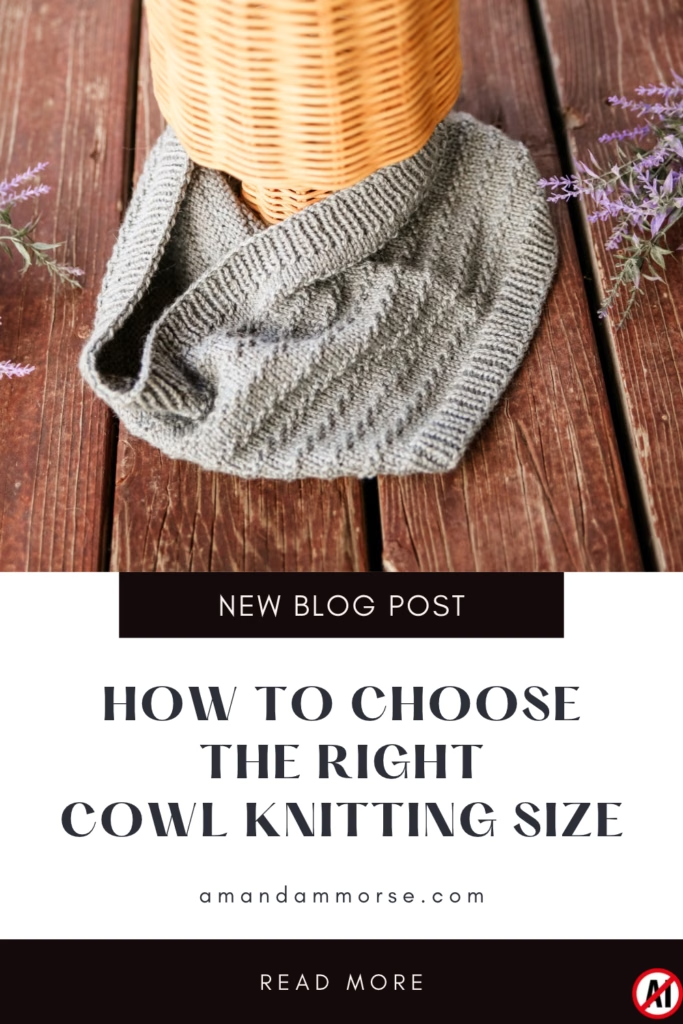
I love that cowls can have such different personalities. My Roman Cowl has a looser fit, while my Miriam Cowl sits closer around the neck.
Neither fit is better. The goal is to choose the one you will enjoy wearing, then make sure your yarn and stitch pattern help you get there.
What Materials Do You Need to Choose Your Cowl Knitting Size?
Start with a flexible measuring tape, your chosen yarn, suitable knitting needles, and the pattern you want to use. A cowl you already like wearing is helpful, too.
For yarn ideas, read my Best Yarn for Knitting Scarves: Soft Yarn Picks for Projects You’ll Actually Wear. Many of the same considerations apply to cowls because softness, drape, and comfort against your neck matter just as much.
You will also need a gauge swatch worked in the stitch pattern your cowl uses. If you are following a pattern, check which stitch pattern its stated gauge is measured in before comparing your results.

Wash and dry your swatch as you plan to care for the finished cowl. Measure it after it is fully dry, without pulling it wider or taller.
That little square tells you much more about your finished fit than the yarn label does. You can feel its thickness, see how it folds, and gently stretch it to check whether it springs back.
How Do You Measure Your Head and Neck for a Cowl?
For a pull-on cowl, take both measurements. Your neck measurement helps you plan the wearing fit, and your head measurement helps you check the opening.
Measure around your neck where you want the cowl to sit, keeping the tape comfortable rather than tight. Then measure around the widest part of your head, usually across the forehead and around the fullest part at the back.
A cowl does not have to measure the same as your head when resting. Stretchy fabric can have a smaller relaxed circumference and still slide over your head comfortably.
However, the fabric AND both edges need to stretch far enough. A flexible body will not help much if the bind-off edge stops at your forehead!
You can also use the tape to make a loose loop around your neck at your proposed circumference. This helps you picture the amount of room, although a narrow tape cannot show how thick knitted fabric will feel.
What Is the Difference Between Circumference and Laid-Flat Width?
Circumference is the measurement all the way around the cowl. Laid-flat width is the distance across the flattened tube.
For a simple tube, double the laid-flat width to find its circumference. A cowl measuring 12 inches across when laid flat has a circumference of approximately 24 inches.
Height is measured from the bottom edge to the top edge. Do not double that measurement.
Always check how a pattern labels its finished measurements. Confusing width with circumference can make your planned cowl knitting size twice as large—or half as large—as you intended.
How Wide Should a Close-Fitting or Loose Cowl Be?
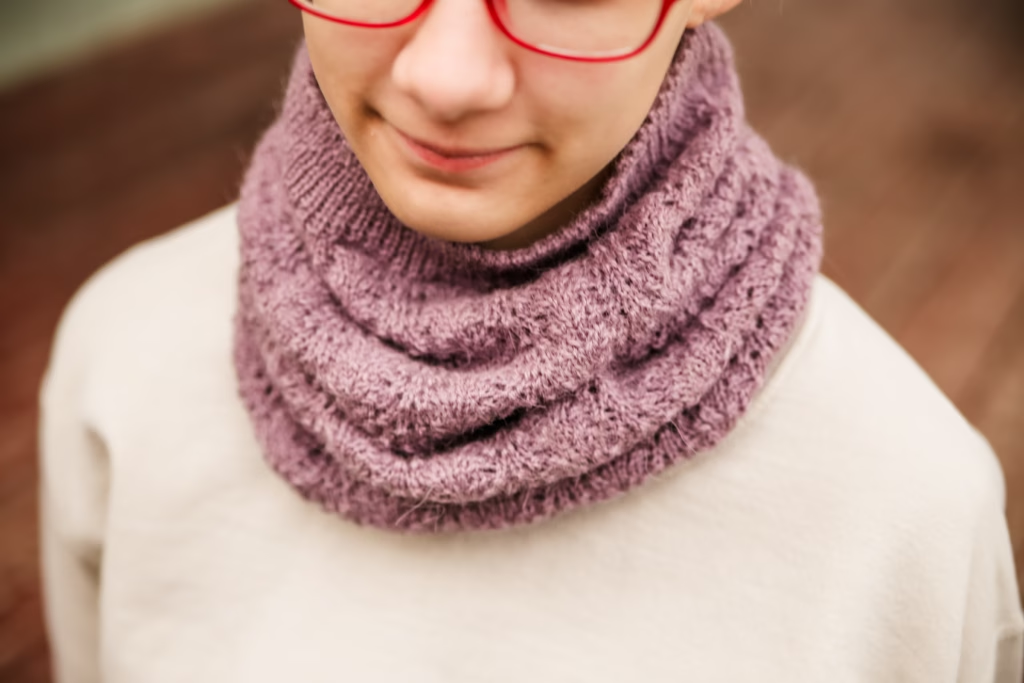
A close-fitting cowl sits near your neck with enough room to feel comfortable when you turn your head or tuck it into a coat. It does not need to squeeze your neck to keep you warm.
My Miriam Cowl is an example of that closer-fitting style. Its fit is useful to keep in mind when you want neck coverage without a large loop hanging down your chest.
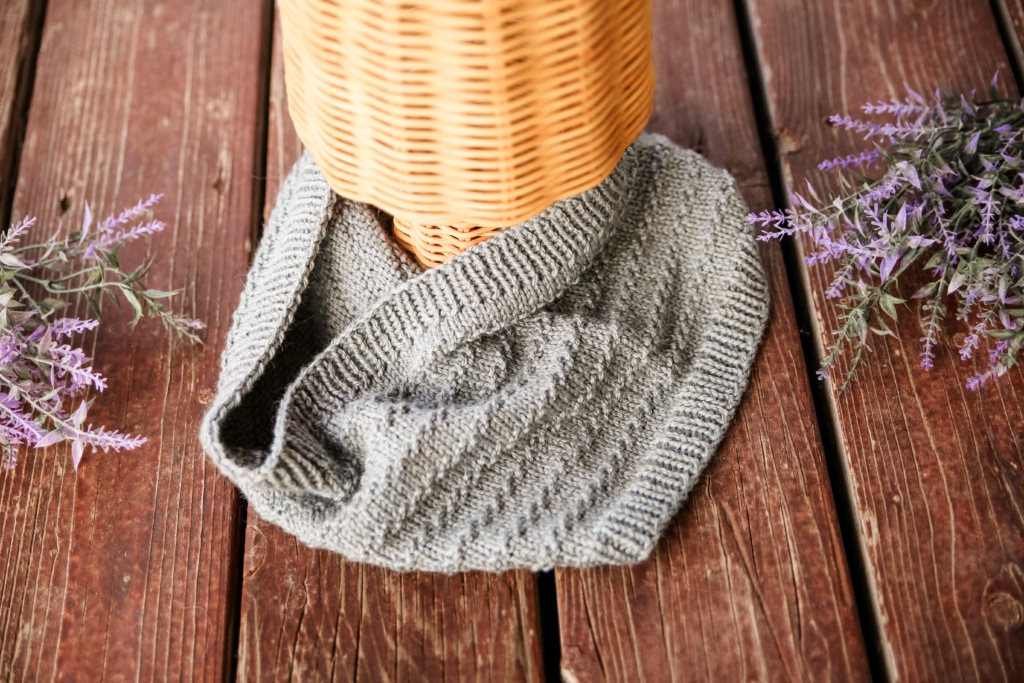
A looser cowl has more circumference, which lets the fabric fall away from your neck. My Roman Cowl is an example of this more relaxed fit.
The extra room gives the fabric space to drape, though it may also leave more space for cold air. Think about whether you want an accessory that hangs loosely or one that stays nearer your neck.
As rough adult starting points, a single-loop cowl might measure around 20–24 inches in circumference for a closer fit, or around 26–32 inches for a roomier fit. These are planning ranges, not sizing rules: the wearer, fabric thickness, stretch, and desired drape can all change the result.
Choose your cowl knitting size from the actual measurements and fabric rather than relying only on a label such as adult or one size.
How Tall Should You Knit a Cowl?
Circumference controls the room around you. Height controls the amount of fabric available to cover, fold, or gather around your neck.
For an adult single-loop cowl, roughly 6–8 inches can be a useful starting point for a shorter style. Around 9–12 inches gives you more fabric to gather or fold, depending on the yarn and stitch pattern. If you want to be able to pull it up over your head then you will want to go 15-18ins.
A tall cowl does not necessarily stand upright. Soft fabric may collapse into folds, while a firm fabric may hold its shape more.
That means adding height to a loose cowl may create more drape instead of bringing it closer to your neck. If you want a closer fit, check the circumference first.
For a folded style, remember that folding the cowl in half reduces its visible height and creates two layers. A 12-inch-tall tube folded in half gives approximately 6 inches of coverage.
Try your work on as you go when the construction allows it. If you are changing a pattern, account for the finishing border and complete any required stitch repeats before binding off.
How Much Stretch Should You Allow When Choosing a Cowl Knitting Size?
Think about relaxed size, comfortable stretch, and recovery.
Relaxed size is the measurement of the fabric at rest. Comfortable stretch is how far it opens without a struggle. Recovery is how well it returns to its original shape afterward.
A cowl can have positive ease around the neck—meaning it is larger than your neck measurement—while still needing to stretch to pass over your head. Those are two different fit checks.
For example, someone with a 15-inch neck and a 22-inch head might consider a cowl with a 20-inch relaxed circumference. It would have room around the neck, but its body and edges would need to stretch comfortably beyond the head measurement for easy dressing.
Do not use the absolute maximum stretch of your swatch as your target. You want the cowl to go on easily without straining the stitches or feeling uncomfortable against your face.
Test your chosen cast-on and bind-off on the swatch, too. An edge that looks neat but barely stretches can change the usability of the entire cowl.
How Do Yarn Weight and Stitch Patterns Affect Finished Size?
Yarn weight affects thickness, but it does not tell you the finished measurements by itself. Your gauge determines how much fabric a given number of stitches produces.
A bulky cowl can feel fuller around the neck than a fingering-weight cowl with the same measured circumference. That extra thickness also matters when you fold it or wear it under a coat.
Fiber and fabric structure matter, too. Some yarns create springy fabric, while others drape more heavily or grow after washing. Let your washed swatch guide your choice.
Stitch patterns add another variable:
- Ribbing often draws inward at rest and stretches across its width.
- Cables commonly pull fabric narrower than stockinette worked with the same stitch count.
- Lace can open noticeably during blocking, changing both width and height.
- Garter stitch and textured knit-and-purl patterns can have different proportions from stockinette.
This is why swapping stitch patterns without checking gauge can change your cowl knitting size even when you keep the same yarn, needles, and stitch count.
Block your swatch to a finish you can realistically maintain. Stretching lace aggressively to reach a measurement may produce a different fit from gently washing and laying the finished cowl flat.
How Do You Calculate Stitches for Your Chosen Circumference?
For a simple cowl worked from the bottom up in the round, multiply your desired finished circumference by your washed stitch gauge.
For example, 24 inches multiplied by 5 stitches per inch gives you 120 stitches.
Next, check the stitch-pattern multiple. If the design requires a multiple of 8 stitches, 120 works because it contains 15 complete repeats. If your calculation does not match the repeat, compare the nearest suitable stitch counts and calculate their finished circumferences before choosing.
Include any additional stitches required by the construction or pattern instructions. Cowls worked sideways use a different relationship between stitches, rows, height, and circumference, so this formula does not apply to every design.
Changing the dimensions also changes yarn requirements. Check your available yardage before making a cowl wider or taller.
What Cowl Patterns Should You Knit Next?
Once you have an idea of the fit you want, try one of these projects:
- Roman Cowl: Choose this for a looser-fitting cowl and use its finished measurements as a reference for relaxed drape.
- Peace Cowl: A chunky option with knit-and-purl texture, useful for exploring how thicker fabric feels around the neck.
- Wheat Cowl: A lightweight lace option for seeing how finer fabric and blocking affect the finished result.
- Miriam Cowl: A closer-fitting lace option when you prefer your cowl to sit nearer your neck.
Compare the finished measurements, gauge, and yarn recommendations before choosing. The photos help you picture the style, while the measurements help you decide how that style will fit you.

Your best cowl knitting size is the combination of circumference and height that feels comfortable and works with your clothes. Measure first, check your washed fabric, and give the edges just as much attention as the body.
Do you prefer a cowl that sits close around your neck or one with a little more room to drape? Tell me in the comments—I would love to hear what makes a cowl comfortable for you!
This post may contain affiliate links. If you purchase through one of these links, I may earn a small commission at no extra cost to you.