
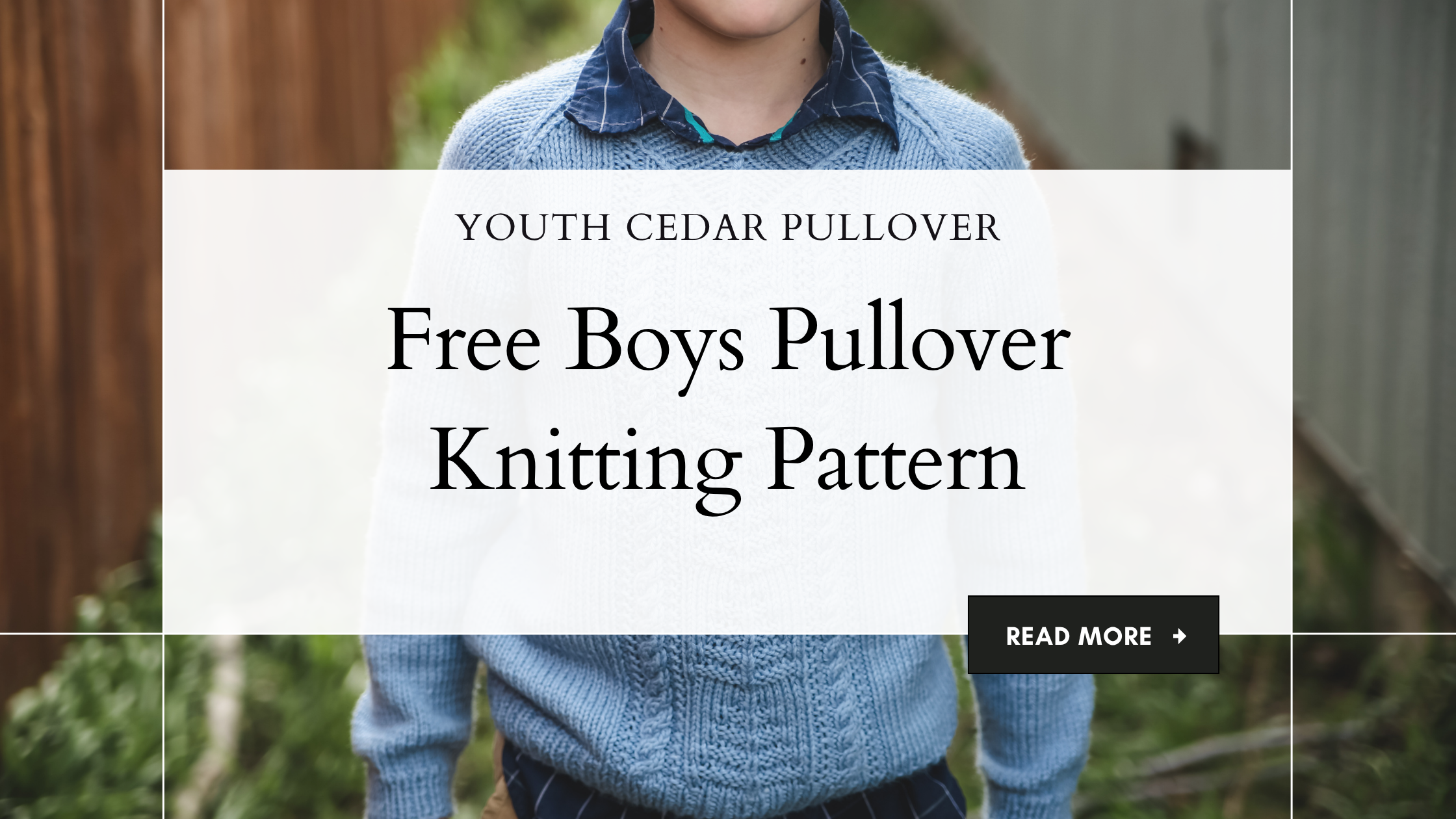
This free boys pullover knitting pattern is a worsted weight sweater pattern designed for boys who need something warm, wearable, and still interesting enough to knit.
The Youth Cedar Pullover is a boys sweater knitting pattern with a classic v-neck shape, set-in sleeves, and a bold center tree panel running up the front. The trees are framed with cable details along the outside, giving this sweater just enough texture without making the whole project feel overwhelming. If you have been looking for a free boys pullover knitting pattern that feels handsome, practical, and a little more special than a plain stockinette sweater, this one is such a fun project to cast on.

The Youth Cedar Pullover is worked flat and seamed together, which gives the sweater structure and makes it a great option if you like knitting pieces separately before finishing the garment.
It is also knit in worsted weight yarn, so it works up faster than a fingering or sport weight sweater while still giving you a sturdy, everyday pullover. The finished sweater has that classic handmade look with a tree-and-cable panel that makes it feel extra special for boys.
What Materials Do You Need for This Free Boys Pullover Knitting Pattern?
For this free boys pullover knitting pattern, I used Premier Anti-Pilling Select, which is a great choice for a child’s sweater because it is soft, practical, and made to hold up better with wear.
Since this is a worsted weight pullover knitting pattern, you will want a yarn that gives nice stitch definition. That really matters here because the front panel includes trees and cable details, and you want those textures to show clearly. A smooth worsted weight yarn helps the cable stitches stand out without getting lost in fuzz or heavy texture.
This boys sweater knitting pattern includes instructions for sizes 3/4 years through 13/14 years, so you can knit it for younger boys and older kids too. I love having a pattern with a wider size range because it makes it easier to come back to the same design again later.

Because this sweater is worked flat and seamed, you will also want your usual finishing supplies nearby. Stitch markers, a cable needle, a tapestry needle, and a good measuring tape will all come in handy while working through this set-in sleeve sweater pattern.
The seams help give this sweater a more polished shape, especially around the shoulders and sleeves. If you have mostly knit raglan sweaters before, this is a great way to try a different sweater construction without jumping into anything too wild.
How Is the Youth Cedar Pullover Worked?
The Youth Cedar Pullover is a v-neck sweater knitting pattern that is worked flat in pieces and then seamed together at the end.
The front has the main design feature: a center tree panel with cable details along the outside of the trees. That panel gives the sweater such a strong, outdoorsy look without making the entire project complicated from edge to edge. The rest of the sweater keeps things wearable and classic, which lets the tree-and-cable section be the main focus.
This cable sweater knitting pattern for boys uses set-in sleeve construction, so the finished pullover has a more traditional sweater shape. The set-in sleeves create a neat fit through the shoulders, and the v-neck adds a classic detail that works really well for boys.

Since this free boys pullover knitting pattern is seamed, take your time with measuring as you go. Matching your pieces carefully before sewing them together will help the sweater come out even and clean.
I also recommend paying close attention to the center panel as you work. The trees and cables are the part everyone will notice first, so it is worth slowing down a little there and making sure everything lines up nicely.
What Other Boys Sweater Knitting Patterns Should I Try Next?
If you like this free boys pullover knitting pattern, you may also enjoy some of my other boys sweater patterns. These are great options if you want more practical handmade sweaters for everyday wear.
• Youth Peter Sweater
• Youth Granite Sweater
• Youth Michael Sweater
• Youth Judah Sweater
• Youth Noah Sweater
Each of these patterns has its own look and texture, so you can choose the sweater that fits your yarn, your kid, and your knitting mood. Some are more classic, some have more texture, and some are great everyday sweaters that can get lots of use.

The Youth Cedar Pullover fits right in with those patterns while still having its own standout look. The tree panel gives it a strong center detail, the cables add texture, and the v-neck keeps the whole sweater looking neat and wearable.
If you have been wanting a worsted weight pullover knitting pattern that works well for boys and still gives you something fun to knit, this is a great one to add to your list.
Free Youth Cedar Pullover Free Pattern
Size: (3/4y, 5/6y) 7/8y, 9/10y (11/12y, 13/14yrs)
Materials: Approximately (580, 685) 785, 946 (1085, 1243) yds of Premier yarns Anti-Pilling Select 3.5 oz/100g/185yds/170m yarn needle, stitch markers
Needle Size: 7(US) 4.5mm circular needles and dpn, 4(US) 3.5mm circular and dpn
Gauge (tension): 20sts & 28 rows to make 10cm square, using size 7(US) 4.5mm needles working in stockinette stitch
Chest Measurement: (57, 61) 66, 72 (77.5, 85) cm or (22.5, 24) 26.5, 28.5 (31, 34) ins
METHOD
Youth Cedar Pullover is bottom-up raglan pullover in an easy-care yarn. It is worked flat and sewn together. Created for our 6th child, he wanted something soft, warm and comfortable for winter to layer when we go to church.
Abbreviations can be found on the last page.
Note: choose size based on chest measurement for best fit. Measurements above are measurement of the person not sweater measurements.
1X1 RIB PATTERN
Row 1 (right side row) – (k1, p1) across
Row 2 – knit all the knit stitches, purl all the purl stitches.

CEDAR CENTER PANEL STITCH PATTERN:
Row 1 (right side) – p1, k1, p1 k4, p1, k1, p1, k1, m1r, k4, vdd, k4, m1l, k1, p1, k1, p1, k4, p1, k1, p1
Row 2 – k3, p4, k3, p1, k5, p1, k5, p1, k3, p4, k3
Row 3 – p1, k1, p1, cb2/2, p1, k1, p1, k1, p5, k1, p5, k1, p1, k1, p1, cb2/2, p1, k1, p1
Row 4 – k3, p4, k3, p13, k3, p4, p3
Row 5 – p1, k1, p1 k4, p1, k1, p1, k2, m1r, k3, vdd, k3, m1l, k2, p1, k1, p1, k4, p1, k1, p1
Row 6 – k3, p4, k3, p2, k4, p1, k4, p2, k3, p4, k3
Row 7 – p1, k1, p1, cb2/2, p1, k1, p1, k2, p4, k1, p4, k2, p1, k1, p1, cb2/2, p1, k1, p1
Row 8 – k3, p4, k3, p13, k3, p4, p3
Row 9 – p1, k1, p1 k4, p1, k1, p1, k3, m1r, k2, vdd, k2, m1l, k3, p1, k1, p1, k4, p1, k1, p1
Row 10 – k3, p4, k3, p3, k3, p1, k3, p3, k3, p4, k3
Row 11 – p1, k1, p1, cb2/2, p1, k1, p1, k3, p3, k1, p3, k3, p1, k1, p1, cb2/2, p1, k1, p1
Row 12 – k3, p4, k3, p13, k3, p4, p3
Row 13 – p1, k1, p1 k4, p1, k1, p1, k4, m1r, k1, vdd, k1, m1l, k4, p1, k1, p1, k4, p1, k1, p1
Row 14 – k3, p4, k3, p4, k2, p1, k2, p4, k3, p4, k3
Row 15 – p1, k1, p1, cb2/2, p1, k1, p1, k4, p2, k1, p2, k4, p1, k1, p1, cb2/2, p1, k1, p1
Row 16 – k3, p4, k3, p13, k3, p4, p3
Row 17 – p1, k1, p1 k4, p1, k1, p1, k5, m1r, vdd, m1l, k5, p1, k1, p1, k4, p1, k1, p1
Row 18 – k3, p4, k3, p5, k1, p1, k1, p5, k3, p4, k3
Row 19 – p1, k1, p1, cb2/2, p1, k1, p1, k5, p1, k1, p1, k5, p1, k1, p1, cb2/2, p1, k1, p1
Row 20 – k3, p4, k3, p13, k3, p4, p3
BACK
Cast on using smaller needle: (69, 73) 79, 85 (91, 97) sts. Join in the round.
Work in 1×1 ribbing for 1.5ins or 4cms.
Switch to larger needles.
Work in stockinette until piece measures (9.5, 10.5) 11.5, 12.5 (13.5, 14.5) ins or (24, 26) 29, 31 (34, 36) cm measuring from cast on ending after completing a wrong side row.
BACK RAGLAN DECREASES
Cast off (4, 4) 4, 4 (4, 4) stitches at beginning of next 2 rows. (61, 65) 71, 77 (83, 89) sts
Work (2, 2) 2, 2 (2, 2) rows without decreasing.
Decrease 1 st at each end of every 4th row (3, 4) 4, 4 (5, 6) times
(55, 57) 63, 69 (73, 92) sts
Then decrease 1 st each end of every other row (12, 12) 14, 16 (16, 17) times
(31, 33) 35, 37 (41, 43) sts
With right side facing bind off.
FRONT
Cast on using smaller needle: (69, 73) 79, 85 (91, 97) sts. Join in the round.
Work in 1×1 ribbing for 1.5ins or 4cms.
Switch to larger needles.
Set-up Row 1 (wrong side): p[(18, 20) 23, 26 (29, 32)],pm (Cedar Center Panel marker), k3, p4, k3, p13, k3, p4, p3, pm, (Cedar Center Panel Marker), k[(18, 20) 23, 26 (29, 32)]
Work in pattern, working Cedar Center Panel Stitch Chart between markers, until piece measures (9.5, 10.5) 11.5, 12.5 (13.5, 14.5) ins or (24, 26) 29, 31 (34, 36) cm measuring from cast on ending after a completing a wrong side row.
FRONT RAGLAN DECREASES (WORKED AT THE SAME TIME AS NECK DECREASE)
Cast off (4, 4) 4, 4 (4, 4) stitches at beginning of next 2 rows. (61, 65) 71, 77 (83, 89) sts
Work (2, 2) 2, 2 (2, 2) rows without decreasing.
Decrease 1 st at each end of every 4th row (3, 4) 4, 4 (5, 6) times
(55, 57) 63, 69 (73, 92) sts
Then decrease 1 st each end of every other row (12, 12) 14, 16 (16, 17) times
LEFT FRONT NECK SHAPING (WORKED AT THE SAME TIME AS RAGLAN DECREASES)
Start neck shaping after completing (12, 16) 18, 20 (22, 24) rows of raglan shaping.
Work until (27, 28) 30, 32 (35, 38) sts are on the working needle, put remaining sts on a stitch holder, turn.
Decrease 1 st at neck edge of next (8, 10) 10, 10 (12, 10) rows.
Then decrease 1 st at neck edge every other row (6, 5) 6, 7 (7, 10) times.
Continue with raglan decreases until 3 remain.
Next row – k1, k2tog
Next row – p2
Next row – k2tog
Fasten off.
RIGHT FRONT NECK SHAPING
Rejoin yarn to work on stitch holder.
Decrease 1 st at neck edge of next (8, 10) 10, 10 (12, 10) rows.
Then decrease 1 st at neck edge every other row (6, 5) 6, 7 (7, 10) times.
Continue with raglan decreases until 3 remain.
Next row – k1, k2tog
Next row – p2
Next row – k2tog
Fasten off.
SLEEVES (MAKE 2)
With smaller needles, cast on (38, 38) 40, 42 (44, 46) sts.
Work for 1.5ins or 4cms in 1×1 ribbing.
Change to larger needles and begin working in stockinette stitch (knit every right side row, purl every wrong side row).
SLEEVE SHAPING TO UNDERARM
Work (2, 2) 2, 2 (2, 2) rows in stockinette stitch.
Then increase 1 st at each end of every following 12th row (0, 0) 0, 4 (0, 6) times
Then increase 1 st at each end of every following 14th row (0, 0) 5, 2 (5, 1) times
Then increase 1 st at each end of every following 16th row (0, 2) 0, 0 (1, 0) times
Then increase 1 st at each end of every following 18th row (0, 2) 0, 0 (0, 0) times
Then increase 1 st at each end of every following 20th row (1, 0) 0, 0 (0, 0) times.
Then increase 1 st at each end of every following 22th row (2, 0) 0, 0 (0, 0) times.
(44, 46) 50, 54 (56, 60) sts
Continue in stockinette stitch until sleeve measures (9.5, 10.5) 11.5, 13 (14, 14.5) ins or (24, 26) 29, 32.5 (35, 36) (or desired length) measuring from cast on edge and finishing after completing a wrong side row.
SLEEVE HEAD
Cast off (4, 4) 4, 4 (4, 4) stitches at beginning of next 2 rows.
Work (2, 2) 2, 2 (2, 2) rows without decreasing.
Decrease 1 st at each end of every 4th row (3, 4) 4, 4 (5, 6) times
(30, 30) 34, 38 (38, 40) sts
Then decrease 1 st each end of every other row (12, 12) 14, 16 (16, 17) times
(6, 6) 6, 6 (6, 6) sts
Bind off.
NECKBAND
Sew raglan seams.
Pick up and knit (6, 6) 6, 6 (6, 6) sts from left sleeve,
(20, 20) 22, 24 (25, 28) sts down the left front neck,
1 st at center of “v”, pm,
(20, 20) 22, 24 (25, 28) sts up right front neck,
(6, 6) 6, 6 (6, 6) sts from right sleeve,
(31, 33) 35, 37 (41, 43) sts from the back.
Join in the round. (84, 88) 92, 98 (108, 112) sts
V-Neck rounds – work in k1p1 ribbing to 2 sts before center stitch marker, work vdd, continue in k1p1 around
Continue repeating v-neck rounds until the neck ribbing measures 1in or 2.5cms.
Bind off in pattern.
FINISHING
Sew remaining seams, weave in all ends and block as desired.
ABBREVIATIONS
CB2/2 – place the next 2sts on cable needle and hold in back, knit the next 2sts, then knit the 2sts on the cable needle
K – knit
K2tog -knit 2 stitches together
M1L – With left needle pick up strand between 2 stitches front to back. Knit through back loop
M1R – With left needle pick up strand between 2 stitches back to front. Knit through front loop
P – purl
PM – place marker
SM – slip marker
SSK – slip, slip, knit the slipped sts together
ST – stitch
STS – stitches
VDD – vertical double decrease – slip the next 2 sts together as if to knit, knit the next st, pass over the 2 slipped sts together

What do you think of the Youth Cedar Pullover? I would love to know who you would knit this free boys pullover knitting pattern for first, so leave a comment and tell me what size you are planning to make.
This post may contain affiliate links. If you make a purchase through one of my links, I may earn a small commission at no extra cost to you.