
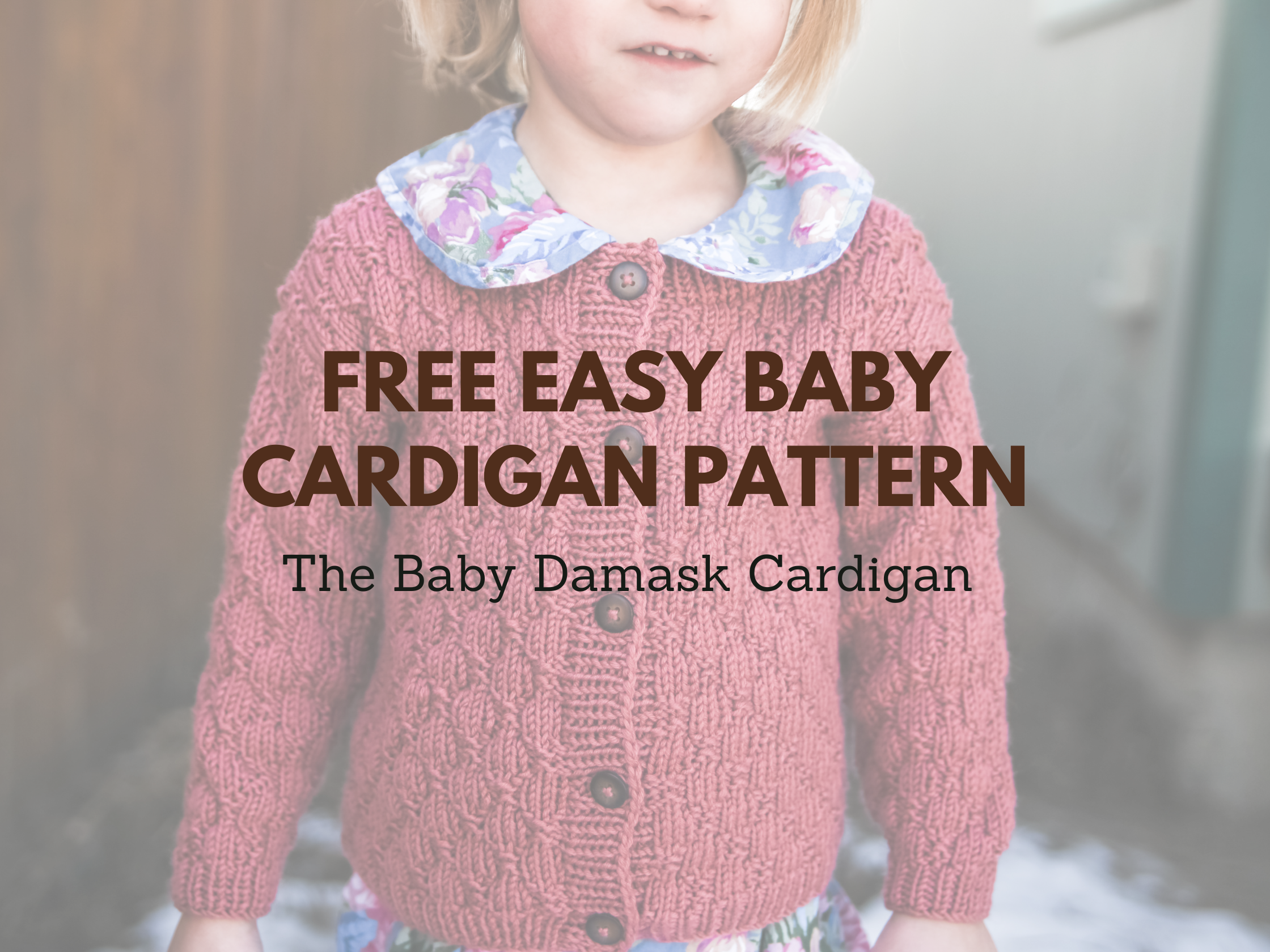
This free easy baby cardigan pattern is a sweet and simple project that also fits right in with your collection of free sweater knitting patterns.
If you’ve ever wanted a classic baby cardigan that looks polished but doesn’t feel overwhelming to knit, this is exactly what you’ve been looking for. The Baby Damask Cardigan is worked flat and sewn together, making it approachable and easy to manage, even if you’re still getting comfortable with garment construction. With its timeless drop sleeve shape, crew neck, and all-over textured stitch that resembles damask wallpaper, it’s the kind of piece that looks far more complicated than it actually is.
One of the biggest struggles with baby garments is finding something that looks special without requiring complicated shaping or techniques. This free easy baby cardigan pattern solves that by keeping the construction simple while letting the texture do all the work. With sizes from newborn through 24 months, you can knit this again and again as your little one grows.

If you’ve been searching for a go-to baby sweater that feels classic, wearable, and gift-worthy, this one checks every box. It’s simple enough to enjoy knitting, but detailed enough to feel like a finished piece you’re proud of.
This is one of those patterns that works just as well for everyday wear as it does for special photos or gifting. Once you knit one, you’ll already be planning your next.
What materials do you need for this free easy baby cardigan pattern?
For this free easy baby cardigan pattern, I kept the materials simple and easy to find, because the goal here is a stress-free project from start to finish. I used Premier Anti-Pilling Everyday Worsted, which is one of my favorite budget-friendly yarns for baby knits. It’s soft, durable, and holds texture beautifully.
You’ll also need size 6 (4.25 mm) straight needles and size 7 (4.5 mm) straight needles to get the right gauge and drape. Other essentials include stitch markers, a yarn needle for seaming, and blocking mats to finish your cardigan neatly and help that textured pattern really shine.
I always recommend not skipping the blocking step for this one. It really helps open up the stitch pattern and gives your finished cardigan that clean, structured look.

Taking a little extra time with your materials and finishing steps makes a big difference in how professional your final piece looks. It’s worth it every single time.
How is this free easy baby cardigan pattern constructed?
This free easy baby cardigan pattern is worked flat in pieces and then sewn together, which makes it feel much more manageable than knitting everything in one piece. The drop sleeve construction keeps the shaping simple, and the crew neck gives it that classic, everyday look.
The textured stitch pattern is created using simple knits and purls, so once you get into the rhythm, it’s actually very relaxing to work on. I like to think of it as a great “watch something and knit” project once you’ve established the pattern.
A helpful tip is to keep your pieces organized as you go and use stitch markers to track repeats if needed. It makes seaming and assembly go so much smoother in the end.

Once everything is sewn together and blocked, you’ll really see that damask-inspired texture come to life. It’s one of those moments where all the simple steps add up to something that looks incredibly detailed.
Looking for more baby cardigan knitting patterns?
If you love this free easy baby cardigan pattern, here are a few more patterns you might enjoy working through next:
- youth damask cardigan
- baby wheat cardigan
- baby john hooded cardigan
- baby granite sweater
- baby micheal sweater
- Baby Lydia Cardigan
These all have their own unique textures and constructions, but they share that same approachable style that makes them fun to knit and easy to wear.
Having a few go-to baby sweater patterns on hand is honestly one of the best things, especially when you need a quick gift or want something relaxing to cast on.

Each of these patterns builds on similar skills, so the more you knit, the easier they all become. It’s a great way to grow your confidence without feeling overwhelmed.
Baby Damask Cardigan Pattern
Size: 0-3m, 3-6m (6-12m, 12m) 18m, 24m
Materials: Approximately 1, 2 (2, 2), 2, 3 skeins of Premier Yarns Anti-Pilling Everyday Worsted, 189 yds / 173 m per 100 g; 4, 4 (5, 5), 5, 5 buttons measuring ½ in / 13 mm; tapestry needle; stitch markers; and waste yarn or stitch holders.
Needle Size: US 6 (4 mm) and US 7 (4.5 mm) straight or circular needles. All pieces are worked flat.
Gauge (tension): 20 sts and 24 rows per 4 × 4 in / 10 × 10 cm after blocking, using US 7 (4.5 mm) needles.
To fit chest circumference: 41, 44 (47, 50), 52, 54 cm / 16¼, 17¼ (18½, 19¾), 20½, 21¼ in.
METHOD
This drop-shoulder cardigan is worked flat from the bottom up in separate pieces, then seamed. Ribbed neck and front bands are added after the shoulder seams are joined. The cardigan is intended to have approximately 4 in / 10 cm of positive ease, with the amount varying by size.
DAMASK STITCH PATTERN
Row 1 (RS): [k3, p1, k1, p1] across.
Row 2 (WS): [k3, p3] across.
Row 3: Repeat Row 1.
Row 4: Repeat Row 2.
Row 5: Repeat Row 1.
Row 6: [p3, k1, p1, k1] across.
Row 7: [p3, k3] across.
Row 8: Repeat Row 6.
Row 9: Repeat Row 7.
Row 10: Repeat Row 6.
Repeat Rows 1–10.
Work the stitch pattern between the two selvedge stitches specified in the piece instructions. Where the available stitches do not fit a complete six-stitch repeat, work as many complete repeats as possible, then work the beginning of the repeat over the remaining stitches.
During shaping, maintain the established stitch columns rather than restarting the repeat at a newly shaped edge.
BACK
Cast on 56, 56 (62, 62) 62, 68 sts using the smaller circular needles
Work 2, 2 (2, 2.5) 2.5, 2.5 cms or .75, .75 (.75, 1) 1 1 ins of (k1, p1) rib.
Switch to larger size circular needles.
Work 1 selvedge stitch, the Damask Stitch Pattern over the center stitches, then 1 selvedge stitch. Knit the first and last stitch of every row. Advance one Damask pattern row on every row worked.
Continue until the back measures 14, 15.5 (17.5, 19.5), 21, 22.5 cm / 5½, 6 (7, 7¾), 8¼, 8¾ in from the cast-on edge. Place a removable marker at each edge to mark the bottom of the armhole.
Continue in the established pattern until the back measures 22.5, 24.5 (27, 30), 32, 34 cm / 8¾, 9¾ (10¾, 11¾), 12½, 13½ in from the cast-on edge, ending after a WS row.
SHOULDERS
(12m, 18m 24m only)
Bind off x, x (x, 5) 5, 6 sts at the beginning of the next 2 rows.
(all sizes)
Bind off 0, 0 (0, 5) 5, 6 sts at the beginning of the next row, Work until 17, 17 (19, 8), 8, 9 sts are on the working needle after the bind-off, then place the unworked stitches on waste yarn or a stitch holder.
Turn and bind off 3, 3 (3, 3) 3, 3 sts, work to the end of the row.
Turn and bind off remaining 14, 14 (16, 5) 5, 6 sts
With right side facing, rejoin yarn to the sts on the stitch holder/spare yarn, bind off 22, 22 (24, 26) 26, 26 sts, work remaining sts.
Bind off 0, 0 (0, 5) 5, 6 sts, work to the end of the row.
Turn and bind off 3, 3 (3, 3) 3, 3 sts, work to the end of the row.
Turn and bind off the remaining 14, 14 (16, 5), 5, 6 sts.
LEFT FRONT (if you knit left-handed this is your right front)
Cast on 26, 26 (29, 29) 29, 32 sts using smaller needle
Work 2, 2 (2, 2.5) 2.5, 2.5 cms or .75, .75 (.75, 1) 1 1 ins of (k1, p1) rib.
Switch to larger size circular needles.
Work 1 selvedge stitch, the Damask Stitch Pattern over the center stitches, then 1 selvedge stitch. Knit the first and last stitch of every row. Work partial repeats where necessary, maintaining the established stitch columns.
Continue until the front measures 14, 15.5 (17.5, 19.5), 21, 22.5 cm / 5½, 6 (7, 7¾), 8¼, 8¾ in from the cast-on edge. Place a removable marker at the sleeve edge to mark the bottom of the armhole.
Continue in the established pattern until the front measures 17.5, 19.5 (22.5, 25), 27, 29 cm / 7, 7¾ (8¾, 9¾), 10¾, 11½ in from the cast-on edge, ending after a RS row.
NECK
Next row (WS): Bind off 8, 8 (9, 9), 9, 9 sts at the neck edge and work to the end.
[18, 18 (20, 20), 20, 23 sts]
Decrease 1 st at the neck edge on each of the next 2, 2 (2, 3), 3, 3 rows.
[16, 16 (18, 17), 17, 20 sts]
Work one row without a neck decrease, then decrease 1 st at the neck edge on the following row. Repeat these two rows once more.
[14, 14 (16, 15), 15, 18 sts]
Continue without further neck decreases until the front measures 22.5, 24.5 (27, 30), 32, 34 cm / 8¾, 9¾ (10¾, 11¾), 12½, 13½ in from the cast-on edge, ending after a WS row.
SHOULDERS
(12m, 18m, 24m only)
Bind off x, x (x, 5) 5, 6 sts, work to end of row
Work the next row without shaping
Bind off x, x (x, 5) 5, 6 sts, work to end of row
Work the next row without shaping
(all sizes)
Bind off remaining 14, 14 (16, 5) 5, 6 sts
RIGHT FRONT (if you knit left-handed this is your left front)
Cast on 26, 26 (29, 29) 29, 32 sts using smaller needle
Work 2, 2 (2, 2.5) 2.5, 2.5 cms or .75, .75 (.75, 1) 1 1 ins of (k1, p1) rib.
Switch to larger size circular needles.
Work 1 selvedge stitch, the Damask Stitch Pattern over the center stitches, then 1 selvedge stitch. Knit the first and last stitch of every row. Work partial repeats where necessary, maintaining the established stitch columns.
Continue until the front measures 14, 15.5 (17.5, 19.5), 21, 22.5 cm / 5½, 6 (7, 7¾), 8¼, 8¾ in from the cast-on edge. Place a removable marker at the sleeve edge to mark the bottom of the armhole.
Continue in the established pattern until the front measures 17.5, 19.5 (22.5, 25), 27, 29 cm / 7, 7¾ (8¾, 9¾), 10¾, 11½ in from the cast-on edge, ending after a WS row.
NECK
Next row (RS): Bind off 8, 8 (9, 9), 9, 9 sts at the neck edge and work to the end.
[18, 18 (20, 20), 20, 23 sts]
Decrease 1 st at the neck edge on each of the next 2, 2 (2, 3), 3, 3 rows.
[16, 16 (18, 17), 17, 20 sts]
Work one row without a neck decrease, then decrease 1 st at the neck edge on the following row. Repeat these two rows once more.
[14, 14 (16, 15), 15, 18 sts]
Continue without further neck decreases until the front measures 22.5, 24.5 (27, 30), 32, 34 cm / 8¾, 9¾ (10¾, 11¾), 12½, 13½ in from the cast-on edge, ending after a RS row.
SHOULDERS
(12m, 18m, 24m only)
Bind off x, x (x, 5) 5, 6 sts, work to end of row
Work the next row without shaping
Bind off x, x (x, 5) 5, 6 sts, work to end of row
Work the next row without shaping
(all sizes)
Bind off remaining 14, 14 (16, 5) 5, 6 sts
SLEEVES (MAKE 2)
Using the smaller needles, cast on 26, 26 (26, 32), 32, 32 sts. Work flat.
Work 1×1 ribbing for 2, 2 (2, 2.5), 2.5, 2.5 cm / ¾, ¾ (¾, 1), 1, 1 in, ending after a WS row.
Change to the larger needles. Work 4 rows of the Damask Stitch Pattern between two selvedge stitches, knitting the first and last stitch of every row.
Work 3 more rows in damask pattern.
Increase Row (RS): K1, M1L, work in established pattern to the last st, M1R, k1. [2 sts increased]
Work the Increase Row on every RS row 5, 7 (7, 3), 3, 4 times, working the intervening WS rows in pattern.
Then work the Increase Row every fourth row 1, 1 (2, 5), 6, 6 times. Maintain the established pattern columns and incorporate the increased stitches into the pattern, working partial repeats where necessary.
[38, 42 (44, 48), 50, 52 sts]
Continue in the Damask Stitch Pattern until the sleeve measures 11.5, 13.5 (15.5, 17.5), 19, 20.5 cm / 4½, 5¼ (6, 7), 7½, 8 in from the cast-on edge. Bind off all stitches.
NECKBAND
Sew both shoulder seams.
With the RS facing and using the smaller needle, pick up and knit:
9, 9 (10, 10), 10, 10 sts along the right front’s horizontal neck bind-off edge;
9, 9 (9, 11), 11, 11 sts along the right neckline curve;
28, 28 (30, 32), 32, 32 sts around the back neckline, including the shaped sections at each side;
9, 9 (9, 11), 11, 11 sts along the left neckline curve;
9, 9 (10, 10), 10, 10 sts along the left front’s horizontal neck bind-off edge.
[64, 64 (68, 74), 74, 74 sts]
Work 1×1 ribbing for 1.5, 1.5 (1.5, 2), 2, 2 cm / ½, ½ (½, ¾), ¾, ¾ in. Bind off in pattern.
FRONT RIB EDGES
LEFT FRONT EDGE
Pick up evenly along the complete front opening, including the short end of the neckband 37, 40 (47, 51) 55, 59 sts along the edge with the smaller sized circular needles.
Work 6, 6 (6, 6) 6, 6 rows of rib (k1, p1).
Bind off in established rib pattern.
RIGHT FRONT EDGE
Pick up and knit 37, 40 (47, 51) 55, 59 sts along the edge with the smaller sized circular needles.
Work 2, 2 (2, 2) 2, 2 rows in k1p1 ribbing
Buttonhole Row: Work 2 sts in established ribbing, k2tog, yo, then [work 8, 9 (8, 9), 10, 11 sts in established ribbing, k2tog, yo] a total of 3, 3 (4, 4), 4, 4 times. Work the final 3 sts in established ribbing.
Work 3, 3 (3, 3) 3, 3 rows in k1p1 ribbing
Bind off in established rib pattern.
FINISHING
Block the pieces to the intended measurements. Center each sleeve’s bound-off edge at the corresponding shoulder seam and sew it into the armhole between the front and back markers. Sew the sleeve and side seams using mattress stitch.
Sew the buttons to the opposite front band, matching the buttonholes. Weave in all ends and lightly block the bands and seams as needed.
ABBREVIATIONS
K – knit
K2tog -knit 2 stitches together
M1L – Insert the left needle under the strand that runs between two stitches from front to back, then knit this strand through the back loop
M1R – Insert the left needle under the strand that runs between two stitches from back to front, then knit this strand
P – purl
PM – place marker
RS — right side
SM – slip marker
SSK – slip, slip, knit the slipped sts together
st/sts — stitch/stitches
WS — wrong sideYO – yarn over

If you make this free easy baby cardigan pattern, I would love to hear how it turned out for you. Leave a comment and tell me what size you made or what yarn you used—I always enjoy seeing your variations and ideas!
This post may contain affiliate links, which means I may earn a small commission at no extra cost to you. Thank you for supporting my work!
Comments are closed.