
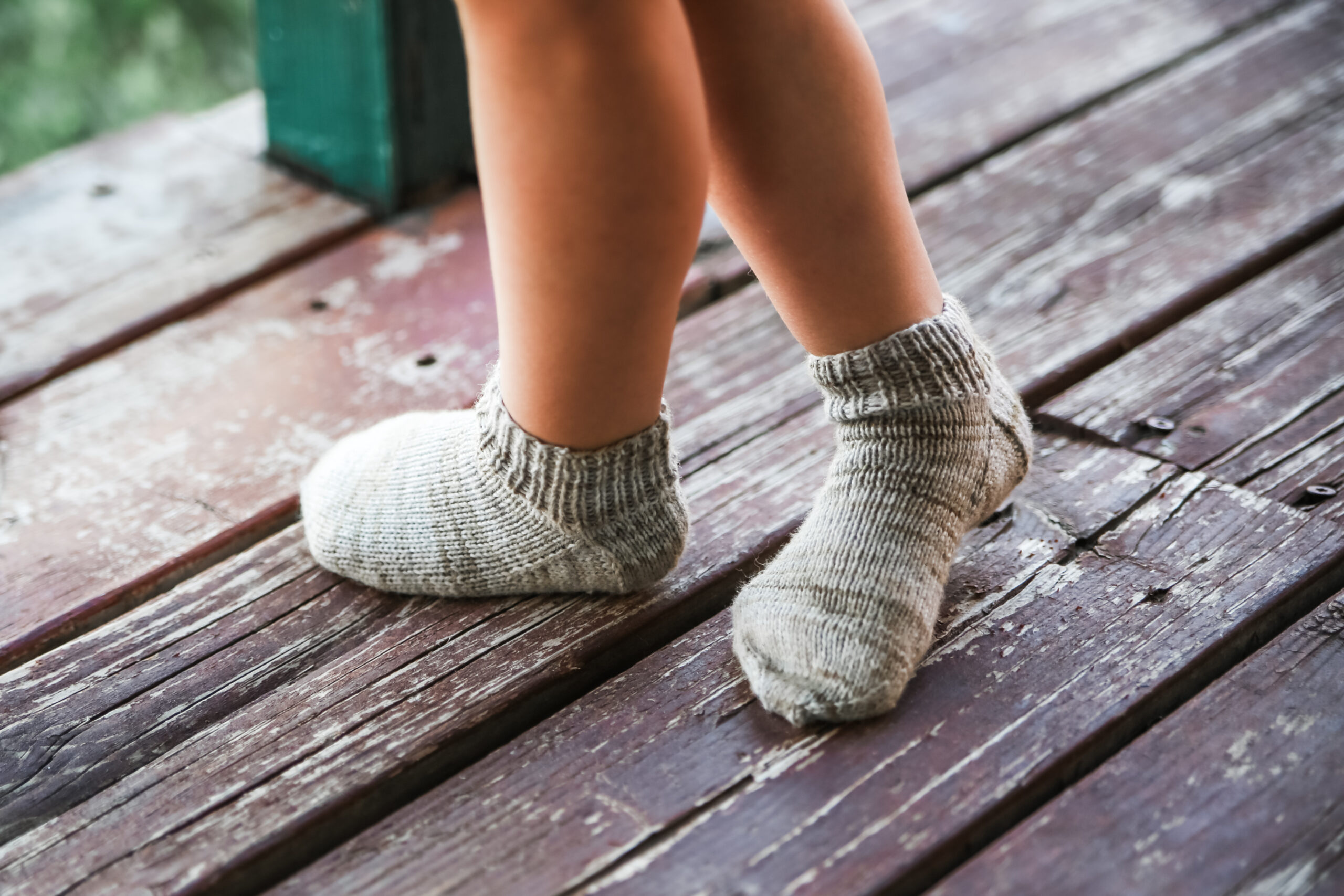
Looking for a simple ankle sock pattern that’s easy to knit, comfortable to wear, and practical for the whole family?
These Vanilla Ankle Socks are exactly that. This beginner-friendly design is part of my collection of free sock knitting patterns and features classic top-down construction with a heel flap, smooth stockinette stitch throughout, and a shorter ankle-height leg that fits beautifully inside everyday shoes. If you need a dependable sock pattern without complicated stitch work, this simple ankle sock pattern is the kind you’ll come back to again and again.

Whether you’re knitting your very first sock or just want a relaxing project to work on while watching TV, this pattern keeps things straightforward and satisfying. With sizing included from baby through large adult, you can make matching socks for the whole family from one versatile pattern.
Sometimes the best patterns are the ones that don’t overcomplicate things. A clean stockinette sock lets beautiful yarn shine, makes sizing easy to customize, and gives you a reliable pattern to memorize after a round or two.
That’s exactly why I designed these Vanilla Ankle Socks. They’re simple, classic, and endlessly useful.
What Materials Do You Need for This Simple Ankle Sock Pattern?
To knit this simple ankle sock pattern, I used KnitPicks Stroll Effects), which gives the socks a soft feel with subtle color variation that keeps plain stockinette interesting. It’s one of my favorite yarns for vanilla socks because it creates enough visual texture to keep the knitting fun without distracting from the clean look of the finished sock.
You’ll also need:
Because this pattern uses fingering weight yarn and smaller needles, the finished fabric is durable enough for everyday wear while still staying lightweight and comfortable in shoes.

If you already keep sock yarn scraps on hand, this is also a fantastic stash-busting project. The ankle length means each pair uses less yarn than traditional crew socks, which makes these especially handy for leftovers.
How Is This Simple Ankle Sock Pattern Constructed?
This simple ankle sock pattern is worked from the top down with a traditional heel flap and gusset, making it a great introduction for knitters who want to learn classic sock construction. If you’ve been intimidated by socks before, this is one of the easiest places to start because there are no lace charts, cables, or complicated shaping details to distract from learning the basics.
The ankle-length leg keeps the project moving quickly, so you get that satisfying finished-object feeling much faster than with taller socks. And because the entire sock is worked in stockinette, this pattern is ideal for self-striping, speckled, or variegated yarns.
Once you’ve made one pair, chances are good you’ll have the construction memorized.

If you like to knit mindless projects while traveling, chatting, or watching a show, this pattern is especially perfect. It gives you all the practicality of handmade socks without requiring constant attention.
Looking for More Free Sock Knitting Patterns?
If you enjoy this simple ankle sock pattern, here are a few more sock patterns you may want to knit next:
Each of these patterns offers a different style and construction detail while still keeping that same practical, wearable feel. Whether you want more texture, a toe-up option, or a slightly dressier look, there’s a little something for every sock knitter in that list.

Ankle socks are one of my personal favorite projects because they knit up quickly, use less yarn, and actually get worn constantly in real life. There’s just something satisfying about finishing a practical project you know will be in regular rotation.
Vanilla Ankle Socks Pattern
Materials:
Yarn: 120 (180, 240), 280, 300, (320, 350) yards of Knitpicks Stroll (100g/462yd)
Needles: Needles: US 1 (2.25 mm) double-pointed needles or a circular needle suitable for working small circumferences in the round.
Notions: Stitch markers, a stitch holder or spare needle for holding the instep stitches, and a blunt yarn needle for grafting and weaving in ends.
Gauge: 8 sts × 11 rounds = 1 in (2.5 cm) in stockinette stitch worked in the round, after blocking.
sizing:
Sizes: Baby (Toddler, Child), Large Child, Adult S (Adult M, Adult L).
Finished Measurements:
Foot circumference (unstretched): 5 (5½, 6½), 7, 7½ (8, 9) in / 12.5 (14, 16.5), 18, 19 (20.5, 23) cm.
Foot length (adjustable): 4 (6, 7¼), 8, 9 (10, 11¼) in / 10 (15, 18.5), 20.5, 23 (25.5, 28.5) cm.
Ankle height is adjustable by changing the number of stockinette rounds worked between the cuff and heel flap. Model is wearing a toddler.
Abbreviations can be found on the last page.
Cuff
Cast on 40 (44, 52) 56, 60, (64, 72) sts, join for working in the round.
Separate stitches on your dpn as follows:
1st needle 20 (22, 26) 28, 30 (32, 36) sts
2nd and 3rd needle 10 (11, 13) 14, 15 (16, 18) sts each needle
Work in 1×1 rib (k1p1 around) for 16 (16, 20) 20, 24 (24, 28) rounds
Then work in Stockinette for 4 (4, 6) 6, 8, (8, 10) rounds.
Heel Flap
Next round: You will work the heel flap on the next 20 (22, 26), 28, 30, (32, 36), sts. Place the remaining 20 (22, 26), 28, 30, (32, 36), sts on hold.
Row 1 (RS): *Sl1 purlwise with yarn in back, k1; repeat from * to the end, turn.
Row 2 (WS): Sl1 purlwise with yarn in front, purl to the end, turn.
Repeat rows 1-2 a total of 8 (10, 12), 13, 14, (16, 18) times.
This is a total of 16 (20, 24), 26, 28, (32, 36) rows.
Heel Turn
Row 1 (RS): Sl1 purlwise with yarn in back, k12 (12, 14), 15, 16 (18, 20), ssk, k1, turn.
Row 2 (WS): Sl1 purlwise with yarn in front, p7 (5, 5), 5, 5 (7, 7), p2tog, p1, turn.
Row 3 (RS): Sl1 purlwise with yarn in back, knit to 1 st before the gap, ssk across the gap, k1 if a stitch remains, turn.
Row 4 (WS): Sl1 purlwise with yarn in front, purl to 1 st before the gap, p2tog across the gap, p1 if a stitch remains, turn.
Repeat Rows 3 and 4 until all heel stitches have been incorporated, ending after a WS row. For Large Child, omit the final k1 and p1 on the last two rows because no stitches remain after the decreases.
There are 14 (14, 16), 16, 18 (20, 22) heel sts remaining.
With RS facing, sl1 purlwise with yarn in back and knit across the remaining heel sts.
Gusset
Pick up and knit 9 (11, 13), 14, 15 (17, 19) sts along the first heel-flap edge: one stitch in each slipped edge stitch, plus one additional stitch at the corner between the heel flap and instep.
Place a marker.
Knit across the 20 (22, 26), 28, 30 (32, 36) held instep sts. Place a marker.
Pick up and knit 9 (11, 13), 14, 15 (17, 19) sts along the second heel-flap edge, including one additional stitch at the corner.
Knit 7 (7, 8), 8, 9 (10, 11) heel sts. Place a beginning-of-round marker at the center of the sole.
There are 52 (58, 68), 72, 78 (86, 96) sts total.
Foot
Remove the beginning-of-round marker at the center of the sole. Knit 10 (11, 13), 14, 15 (16, 18) sts to the next marker. This marker now marks the beginning of the round at the side of the foot. Keep the other marker in place; it divides the instep and sole stitches.
Knit every round until the piece measures 3 (5, 5¾), 6¼, 7 (8, 9) in / 7.5 (12.5, 14.5), 16, 18 (20.5, 23) cm from the back of the heel, or 1 (1, 1½), 1¾, 2 (2, 2¼) in / 2.5 (2.5, 4), 4.5, 5 (5, 5.5) cm short of the desired finished foot length.
Toe
Round 1 (decrease round): K1, ssk, knit to 3 sts before the next marker, k2tog, k1, slip marker, k1, ssk, knit to the last 3 sts of the round, k2tog, k1. 4 sts decreased.
Round 2: Knit, slipping markers as you reach them.
Work Rounds 1 and 2 a total of 6 (7, 8), 9, 10 (10, 12) times, ending after Round 2.
There are 16 (16, 20), 20, 20 (24, 24) sts remaining.
Cut yarn, leaving a 12 in (30.5 cm) tail, then graft the toe closed using Kitchener stitch.
Kitchener stitch:
Divide the remaining stitches equally between two parallel needles, with the instep stitches on one needle and the sole stitches on the other. Hold the wrong sides together. Thread the yarn tail onto a blunt yarn needle.
Setup: Insert the yarn needle purlwise through the first stitch on the front needle and leave the stitch on. Insert the yarn needle knitwise through the first stitch on the back needle and leave the stitch on.
Step 1: Insert the yarn needle knitwise through the first stitch on the front needle and slip that stitch off.
Step 2: Insert the yarn needle purlwise through the next stitch on the front needle and leave it on.
Step 3: Insert the yarn needle purlwise through the first stitch on the back needle and slip that stitch off.
Step 4: Insert the yarn needle knitwise through the next stitch on the back needle and leave it on.
Repeat Steps 1–4 until one stitch remains on each needle. Work Steps 1 and 3 once more to remove the final stitches.
Adjust the grafting tension to match the surrounding stitches, then weave in the end.
For a left-handed video tutorial of this visit my youtube here
Abbreviations
BOR – beginning of round
DPNs – double-pointed needles
k – knit
k2tog – knit 2 stitches together
p – purl
p2tog – purl 2 stitches together
pm – place marker
RS – right side
sl1 – slip 1 stitch purlwise unless otherwise instructed
sm – slip marker
ssk – slip the next 2 stitches individually knitwise, then knit them together through their back loops
st – stitch
sts – stitches
WS – wrong side

Have you knit ankle socks before, or are you team full-length socks all the way? Let me know in the comments—I always love hearing what kind of socks you actually wear most often!
This post may contain affiliate links, which means I may earn a small commission if you purchase through those links at no extra cost to you. Thank you for supporting my business so I can continue providing free knitting patterns.