
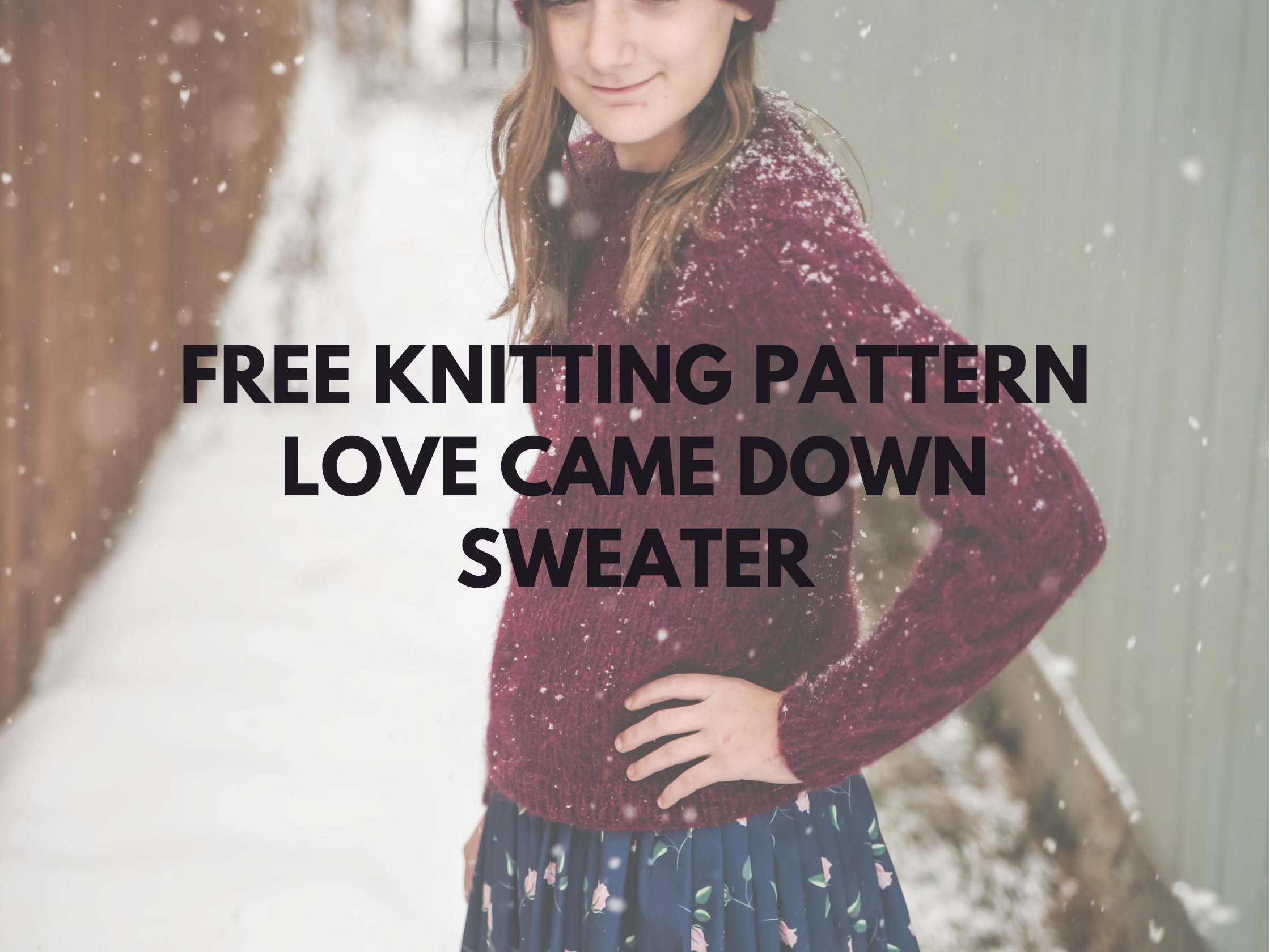
Love Came Down Sweater is a free bottom up raglan sweater pattern that makes a beautiful addition to your collection of free sweater knitting patterns, especially if you’ve been wanting something that feels classic but still has a little personality.
If you’ve ever struggled to find a sweater pattern that’s structured, easy to follow, and still interesting to knit, this one solves that problem in the best way. This Love Came Down Sweater: A Free Bottom Up Raglan Sweater Pattern With Heart Details walks you through a seamless, in-the-round construction with clear shaping and eye-catching cable details that don’t feel overwhelming. It’s a great next step if you’re ready to move beyond basic garments and into something a little more memorable.

If you love free sweater knitting patterns that give you that steady, satisfying progress from hem to neckline, this one really delivers. The construction is predictable in the best way, while the heart cable panels keep things fun and engaging without slowing you down.
It’s the kind of project that feels relaxing to knit but still looks like you put a lot of thought into it. And honestly, those are always my favorite.
What materials do I need for this bottom up raglan sweater pattern?
For this Love Came Down Sweater: A Free Bottom Up Raglan Sweater Pattern With Heart Details, I used KnitPicks Wonderfluff, and it ended up being exactly what I wanted for both look and feel. It’s soft, slightly airy, and gives the cables just enough definition without making the fabric feel heavy. That balance matters so much when you’re working with textured stitches.
You’ll also need circular needles in two sizes for the ribbing and body, along with double-pointed needles for the sleeves. Stitch markers are a must here since they help keep your raglan shaping and cable sections nice and organized.
Once everything is on your needles, you’ll notice pretty quickly how smoothly this yarn glides and how nicely the stitches settle into place.

This is one of those combinations where the yarn really supports the design instead of fighting it. The softness makes it wearable, and the structure keeps it looking polished.
How does this bottom up raglan sweater pattern come together?
This bottom up raglan sweater pattern is worked in the round from the hem up, which means you get to watch it grow in a really satisfying way. You’ll start with the body, then knit the sleeves separately before joining everything together for the raglan shaping.
The heart cable panels run up the sides of the body and continue into the sleeves, which gives the whole sweater a really balanced look. It’s a small detail, but it makes a big difference in how finished the sweater feels.
The raglan decreases are straightforward and clearly written, so even if this is your first time working this construction, it’s very doable. Just take it step by step and trust the process.

By the time you reach the yoke, everything starts to come together quickly, and that’s always the most exciting part. It’s one of those moments where you can really see the sweater take shape.
Looking for more free sweater knitting patterns like this one?
If you’re loving this style, here are a few more patterns worth checking out:
• Youth Peter Sweater
• Youth Saffron Pullover
• Child Grace Pullover
• Child Anna Cardigan
• Youth Dathan Pullover
Each of these patterns brings something a little different to the table, whether it’s texture, construction, or overall style. They’re all great options if you want to keep building your skills while still making pieces that actually get worn.

If you enjoy knitting sweaters that feel practical but still look special, this Love Came Down Sweater: A Free Bottom Up Raglan Sweater Pattern With Heart Details fits right in with that kind of wardrobe. It’s warm, wearable, and just detailed enough to keep things interesting.
MATERIALS AND INFO
MATERIALS AND INFO
Size: 0-3m, 3-6m (6-12m, 12m) 18m, 24m (3/4y, 5/6y) 7/8y, 9/10y (11/12y, 13/14yrs)
Yarn: Approximately 225, 275 (310, 355) 390, 420 (500, 585) 680, 785 (930, 1045) yds / 205, 250 (285, 325) 355, 385 (455, 535) 620, 720 (850, 955) m of KnitPicks Wonderfluff, 142 yds / 50 g per ball.
Notions: Cable needle, stitch markers including a distinct beginning-of-round marker, stitch holders or waste yarn, and a tapestry needle.
Needle Size: 9(US) 5.5mm circular needles and dpn, 8(US) 5mm circular and dpn
Gauge: 17 sts and 24 rounds = 4 × 4 in / 10 × 10 cm in stockinette stitch worked in the round using larger needles, after blocking.
To Fit Chest Measurement: 41, 44 (47, 50), 52, 54 (57, 61) 66, 72 (78, 84) cm or 16, 17.5 (18.5, 19.5) 20.5, 21.5 (22.5, 24) 26, 28.5 (30.5, 33) ins
METHOD
Love Came Down is a bottom-up raglan pullover. It is worked in the round with cables on the sides and the top of the sleeves. Created for our 4th child. She wanted something for Christmas that she could also wear all year.
Abbreviations can be found on the last page.
Note: choose size based on chest measurement for best fit. Measurements above are measurement of the person not sweater measurements.

Row 1 – p1, k4, cb1/2, cf2/1, k4, p1
Row 2 – p1, tf2/1, cb1/2, k2, cf2/1, tb1/2, p1
Row 3 – p2, k1, cb1/2, k4, cf2/1, k1, p2
Row 4 – p2, cb1/2, k6, cf2/1, p2
Row 5 – p2, k12, p2
Row 6 – p2, k12, p2
Row 7 – p1, cb1/2, k8, cf2/1, p1
Row 8 – p1, k14, p1
Row 9 – p1, k14, p1
Row 10 – p1, k14, p1
Work the Cable Heart Stitch Pattern over the 16 stitches between the cable markers. Repeat Rounds 1–10.
Blank square = knit. Dot = purl. Cable and twist symbols correspond to cb1/2, cf2/1, tb1/2, and tf2/1 as defined in the abbreviations.
PATTERN INSTRUCTIONS
Body
Using smaller circular needles, cast on 88, 96 (100, 104) 108, 112 (116, 124) 132, 140 (152, 160) sts. Place a distinct beginning-of-round marker and join to work in the round, being careful not to twist the stitches.
Work in 1×1 rib (k1p1 around) for 2.5, 2.5 (2.5, 2.5) 3, 3 (3, 3) 4, 4 (4, 4)cms/ 1, 1 (1, 1) 1.25, 1.25 (1.25, 1.25) 1.5, 1.5 (1.5, 1.5)ins
Switch to larger size circular needles.
Set-up round – k15, 17 (18, 19) 20, 21 (22, 24) 26, 28 (31, 33), pm, p1, k4, m1l, k4, m1l, k4, p1, pm (these stitches will be your charted stitch pattern), k30, 34 (36, 38) 40, 42 (44, 48) 52, 56 (62, 66), pm, p1, k4, m1l, k4, m1l, k4, p1, pm (these stitches will be your charted stitch pattern), k15, 17 (18, 19) 20, 21 (22, 24) 26, 28 (31, 33)
[92, 100 (104, 108) 112, 116 (120, 128) 136, 144 (156, 164)sts]
Work as follows: k15, 17 (18, 19) 20, 21 (22, 24) 26, 28 (31, 33), sm, work charted stitch pattern, sm, k30, 34 (36, 38) 40, 42 (44, 48) 52, 56 (62, 66), sm, work charted stitch pattern, sm, k15, 17 (18, 19) 20, 21 (22, 24) 26, 28 (31, 33) for Continue in established pattern until the body measures 5½, 6 (7, 7¾) 8½, 9 (9½, 10) 11, 12 (13, 14) in / 14, 15 (18, 19.5) 21.5, 23 (24, 25.5) 28, 30.5 (33, 35.5) cm from the cast-on edge.
Divide body for underarms
Beginning at center back, arrange the stitches into the following groups without changing their order:
First half of back: 19, 21 (22, 23) 24, 25 (26, 28) 29, 31 (34, 36) sts.
First underarm: 8, 8 (8, 8) 8, 8 (8, 8) 10, 10 (10, 10) sts.
Front: 38, 42 (44, 46) 48, 50 (52, 56) 58, 62 (68, 72) sts.
Second underarm: 8, 8 (8, 8) 8, 8 (8, 8) 10, 10 (10, 10) sts.
Remaining half of back: 19, 21 (22, 23) 24, 25 (26, 28) 29, 31 (34, 36) sts.
Place the front and back stitches on holders or waste yarn. Using separate lengths of yarn, bind off each isolated underarm group without using stitches from the neighboring front or back sections. Leave tails for sewing the underarms. Keep the body’s working yarn attached at center back.
Remove the body cable markers. The body-side cable panels end at the underarms; work the remaining front and back stitches in stockinette during the yoke.
Sleeves (make 2)
Cast on now 22, 24 (24, 24) 26, 26 (28, 30) 32, 34 (36, 38) sts on smaller dpn needles and join in the round.
Work in k1p1 ribbing 2.5, 2.5 (2.5, 2.5) 3, 3 (3, 3) 4, 4 (4, 4)cms/ 1, 1 (1, 1) 1.25, 1.25 (1.25, 1.25) 1.5, 1.5 (1.5, 1.5)ins
Switch to larger dpn needles
Sleeve setup round: K4, 5 (5, 5) 6, 6 (7, 8) 9, 10 (11, 12), pm; p1, k4, M1L, k4, M1L, k4, p1, pm; k4, 5 (5, 5) 6, 6 (7, 8) 9, 10 (11, 12).
24, 26 (26, 26) 28, 28 (30, 32) 34, 36 (38, 40) sts.
You will now have 24, 26 (26, 26) 28, 28 (30, 32) 34, 36 (38, 40) sts on the needles
Work in pattern for 2, 2 (2, 2) 2, 2 (2, 2) 2, 2 (2, 2) rounds
Next row:
Sleeve increase round: K1, M1L, work in established pattern to the last stitch, M1R, k1. 2 sts increased. Work new stitches in stockinette outside the cable panel.
Increase 1 sts on beginning and end of round every other round 3, 0 (0, 0) 0, 0 (0, 0) 0, 0 (0, 0) times,
Then increase 1 sts on each side every 4th round 2, 5 (6, 4) 0, 0 (0, 0) 0, 0 (0, 0) times,
Then increase 1 sts on each side every 6th round 0, 0 (0, 2) 4, 6 (4, 0) 2, 0 (0, 0) times,
Then increase 1 sts on each side every 8th round 0, 0 (0, 0) 1, 0 (1, 1) 0, 0 (0, 0) times,
Then increase 1 sts on each side every 10th round 0, 0 (0, 0) 0, 0 (0, 5) 0, 4 (7, 4) times,
Then increase 1 sts on each side every 12th round 0, 0 (0, 0) 0, 0 (0, 0) 4, 2 (0, 3) times,
[34, 36 (38, 38) 38, 40 (40, 44) 46, 48 (52, 54) sts]
Continue in established pattern until the sleeve measures 4½, 5¼ (6, 7) 7½, 8 (10½, 11½) 11¾, 13 (15, 16) in / 11.5, 13.5 (15, 18) 19, 20.5 (26.5, 29) 30, 33 (38, 40.5) cm from the cast-on edge. Leave the stitches live for the underarm division. Make both sleeves the same length and end on the same cable-pattern round.
Set aside the 8, 8 (8, 8) 8, 8 (8, 8) 10, 10 (10, 10) sts centered on the sleeve beginning-of-round marker: 4, 4 (4, 4) 4, 4 (4, 4) 5, 5 (5, 5) sts from each side of the marker.
Bind off only this isolated underarm group, leaving a tail for sewing. Remove the beginning-of-round marker and place the remaining sleeve stitches on a holder or waste yarn.
26, 28 (30, 30) 30, 32 (32, 36) 36, 38 (42, 44) sleeve sts remain.
Join for the yoke
Resume using the body yarn at center back. Remove old needle markers as you reach them. Use removable markers in the fabric to track sleeve cable placement if needed.
First half of back: K18, 20 (21, 22) 23, 24 (25, 27) 28, 30 (33, 35), pm, k1, pm.
First sleeve: Work 26, 28 (30, 30) 30, 32 (32, 36) 36, 38 (42, 44) held sleeve sts in established pattern, pm.
Front: K1, pm; k36, 40 (42, 44) 46, 48 (50, 54) 56, 60 (66, 70), pm; k1, pm.
Second sleeve: Work 26, 28 (30, 30) 30, 32 (32, 36) 36, 38 (42, 44) held sleeve sts in established pattern, pm.
Remaining half of back: K1, pm; k18, 20 (21, 22) 23, 24 (25, 27) 28, 30 (33, 35) to the distinct beginning-of-round marker.
Four single raglan stitches are now each enclosed by a pair of markers. Keep the distinct beginning-of-round marker at center back.
You know have 128, 140 (148, 152) 156, 164 (168, 184) 188, 200 (220, 232) sts.
Work 1 round
RAGLAN DECREASES
Work raglan decreases as follows:
knit to 2sts before marker, k2tog, sm, k1, sm, ssk, work in pattern to 2sts before marker, k2tog, sm, k1, sm, ssk, knit to 2sts before marker, k2tog, sm, k1, sm, ssk, work in pattern to 2sts before marker, k2tog, sm, k1, sm, ssk, knit to bor marker (8sts decreased).
Work raglan decreases as described above. Remember as you are decreasing to keep the cable on the sleeve in pattern as long as possible:
Every 4th round 0, 0 (0, 0) 0, 0 (2, 2) 3, 4 (4, 4) times,
Then every other round 6, 7 (8, 8) 8, 9 (7, 9) 8, 8 (10, 11) times.
80, 84 (84, 88) 92, 92 (96, 96) 100, 104 (108, 112) sts.
Raglan shaping and neck shaping are worked AT THE SAME TIME using short rows for the last 4 raglan decreases. You can use the method of short rows that works best for you. I am using wrap and turn short rows and describe those below.
Neck shaping — final four raglan decreases
Work these short rows in stockinette, keeping the four marked raglan stitches in stockinette.
Step 1 (RS): Knit to 2 sts before the next raglan marker, k2tog, sm, k1, sm, ssk; knit to 2 sts before the next raglan marker, k2tog, sm, k1, sm, ssk; k2, w&t.
Step 2 (WS): Purl to the center-back beginning-of-round marker, slipping markers as encountered.
Step 3 (WS): Purl to 2 sts before the next raglan marker, p2tog, sm, p1, sm, ssp; purl to 2 sts before the next raglan marker, p2tog, sm, p1, sm, ssp; p2, w&t.
Step 4 (RS): Knit to the center-back beginning-of-round marker, slipping markers as encountered.
Steps 1–4 decrease 8 sts in total, equivalent to one complete raglan decrease round. Repeat Steps 1–4 three more times. Whenever a wrapped stitch is encountered, work its wrap together with the stitch.
48, 52 (52, 56) 60, 60 (64, 64) 68, 72 (76, 80) sts remain.
Knit one complete round, working each remaining wrap together with the stitch it wraps.
NECK
Switch to smaller circular needles. Remove the raglan markers, retaining the beginning-of-round marker.
Work in 1×1 rib for ¾, ¾ (¾, ¾) ¾, ¾ (¾, ¾) 1, 1 (1, 1) in / 2, 2 (2, 2) 2, 2 (2, 2) 2.5, 2.5 (2.5, 2.5) cm.
Bind off loosely in pattern, maintaining enough stretch for the neckline to pass over the wearer’s head.
FINISHING
Sew each bound-off sleeve underarm edge to its corresponding body underarm edge. Close any remaining corner gaps, weave in all ends, and block to the intended finished measurements.
ABBREVIATIONS
BOR: Beginning of round.
cb1/2: Slip the next stitch purlwise to a cable needle and hold at the back. K2 from the holding needle, then k1 from the cable needle.
cf2/1: Slip the next 2 stitches purlwise to a cable needle and hold at the front. K1 from the holding needle, then k2 from the cable needle.
DPNs: Double-pointed needles.
k: Knit.
k2tog: Knit 2 stitches together; 1 stitch decreased.
M1L: Lift the strand between the needles onto the holding needle from front to back, then knit through its back loop; 1 stitch increased.
M1R: Lift the strand between the needles onto the holding needle from back to front, then knit through its front loop; 1 stitch increased.
p: Purl.
p2tog: Purl 2 stitches together; 1 stitch decreased.
pm: Place marker.
RS: Right side.
sm: Slip marker.
ssk: Slip 2 stitches individually knitwise, then knit them together through their back loops; 1 stitch decreased.
ssp: Slip 2 stitches individually knitwise, return them to the holding needle without changing their new mounts, then purl them together through their back loops; 1 stitch decreased.
st/sts: Stitch/stitches.
tb1/2: Slip the next stitch purlwise to a cable needle and hold at the back. K2 from the holding needle, then p1 from the cable needle.
tf2/1: Slip the next 2 stitches purlwise to a cable needle and hold at the front. P1 from the holding needle, then k2 from the cable needle.
WS: Wrong side.
w&t: Wrap and turn. On a knit row, bring the yarn forward, slip the next stitch purlwise, take the yarn back, return the slipped stitch to the holding needle, and turn. On a purl row, take the yarn back, slip the next stitch purlwise, bring the yarn forward, return the slipped stitch to the holding needle, and turn. Work each wrap together with its stitch when subsequently encountered.

If you end up casting this one on, I’d love to hear who you’re making it for or what yarn you choose. Leave a comment below and let’s talk knitting!
This post contains affiliate links. If you purchase through these links, I may earn a small commission at no extra cost to you.
This is very lovely. Will you be extending the sizes to adults please?
I could add it to my list.
I would be so happy to discover this pattern modified to adult sizes – love a bottom-up raglan!
You’re not the first to ask for this. I have it on my to-do list.