
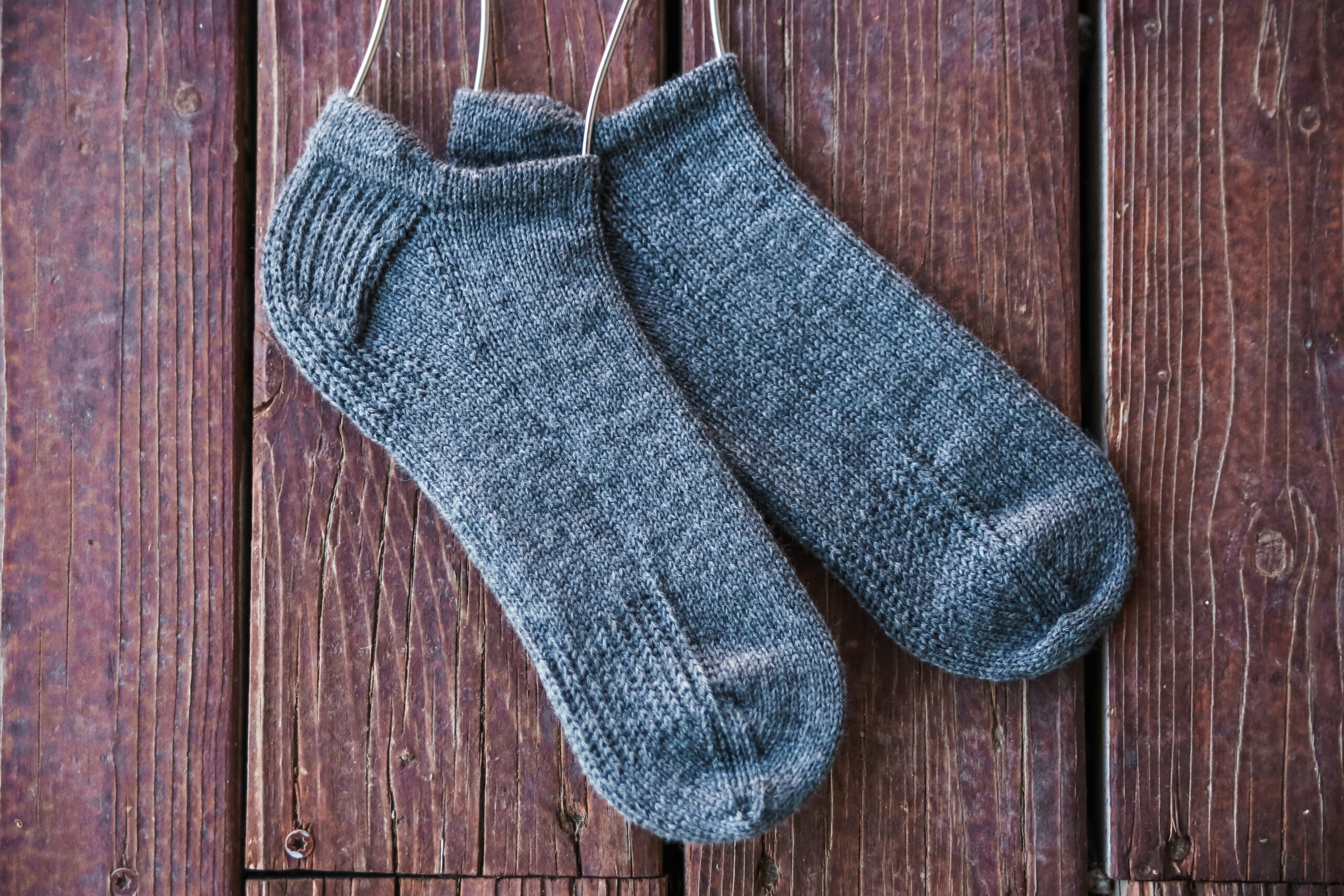
This free ankle sock pattern is part of my growing library of free sock knitting patterns.
It’s designed to solve a problem I hear all the time… you want a quick, everyday sock that actually fits well and doesn’t feel bulky in your shoes.
These shortie socks are worked top down with a heel flap and a short row tabbed heel, so you still get that secure, stay-put fit without all the extra length. The slipped stitch detail across the ball of the foot and sole adds just enough texture to keep things interesting while staying comfortable for daily wear. If you’ve been looking for a free ankle sock pattern that’s simple, wearable, and worth knitting again, this is it.
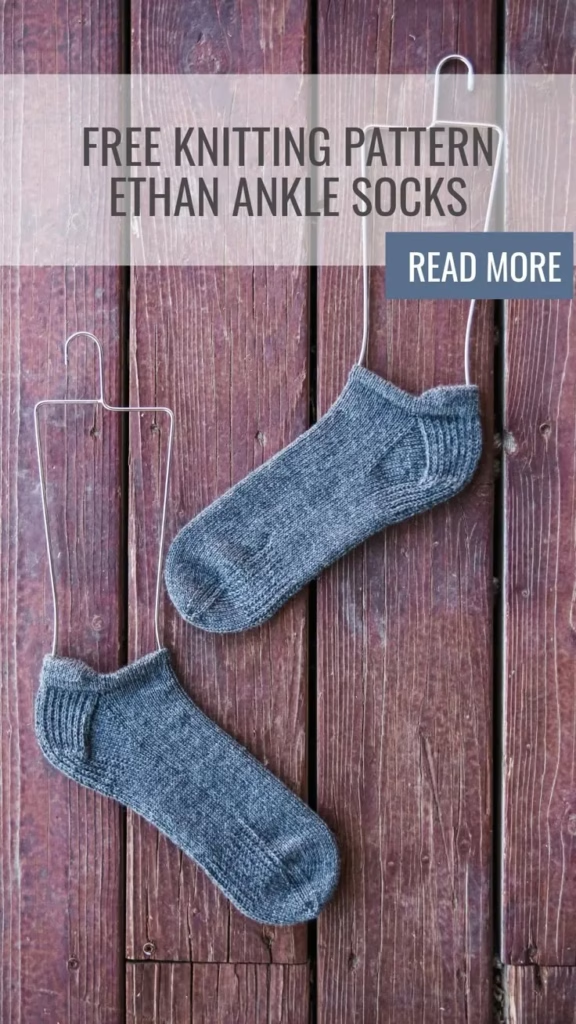
If you’ve ever struggled to find a sock that feels practical but still fun to knit, this one checks both boxes. It’s the kind of pair you’ll finish and immediately cast on again.
Just enough detail. Just enough structure. And a fit that actually works.
What materials do you need for this free ankle sock pattern?
When I knit this free ankle sock pattern, I always reach for a yarn that holds up to real life. These are the exact materials I used and recommend:
Yarn: KnitPicks Stroll (affiliate link)
Needles: US #1 / 2.25mm (affiliate link)
Notions: stitch markers (affiliate link), yarn needle (affiliate link)
Sizing: baby (toddler, child,) lg child, adult S, (M, L)
I love using Stroll for this pattern because it really shows off the slipped stitch texture without feeling stiff.

It’s one of those combinations that just works every time.
How is this free ankle sock pattern constructed?
This free ankle sock pattern is worked from the top down, which makes it super easy to adjust the foot length as you go. The heel flap gives you that classic structure, while the short row tabbed heel keeps things neat and low-profile for an ankle sock.
The slipped stitch pattern (sl1, k1) runs along the ball of the foot and continues across the sole, adding durability right where you need it most. It also gives a subtle texture that makes these feel a little different from your basic stockinette socks.
If you’ve knit socks before, this will feel familiar. If you haven’t, this is still a really approachable place to start.

Once you get into the rhythm, it moves quickly.
Looking for more free ankle sock patterns to knit next?
If you end up loving this free ankle sock pattern, I have a few more you’ll definitely want to check out:
• judah ankle socks
• deborah ankle socks
• simone ankle socks
• vanilla ankle socks
• reuben socks
Each one has a slightly different construction or texture, so you can keep things interesting while building your sock drawer.

There’s something really satisfying about having a stack of handmade socks ready to go.
Ethan Socks Pattern
Materials:
Yarn: 1 (1, 1) 2, 2 (2, 2) skeins of Knitpicks Stroll (50g/231yd)
Needles: US #1 / 2.25mm DPNs (or circular for magic loop)
Notions: stitch markers, needle
Gauge: 8sts x 11rows per inch
sizing:
baby (toddler, child,) lg child, adult S, (M, L)
Finished measurements (unstretched):
Foot Length (adjustable): 4 (6, 7.25), 8, 9, (10, 11.25)”
Ethan Ankle Socks are a simple ankle sock with reinforced back and bottom of heel
and a reinforced ball of the foot to add cushion for comfort but also make the places
where socks wear most, stronger.
Abbreviations can be found on the last page.
Cuff
Cast on 40 (44, 52) 56, 60, (64, 72) sts, join for working in the round.
Separate stitches on your dpn as follows:
1st needle 20 (22, 26) 28, 30 (32, 36) sts
2nd and 3rd needle 10 (11, 13) 14, 15 (16, 18) sts each needle
Work in Stockinette for 4 (5, 5) 5, 5, (5, 6) rounds.
Short rows:
Row 1 – Work across 1
st needle to 1 st remaining on needle, W&T.
Row 2 – Work across to 1 st remaining on 1st needle, W&T.
Row 3 – Work across to 1 st before last wrap, W&T.
Row 4 – Work across to 1 st before last wrap, W&T.
Repeat rounds 3 & 4: 1 (1, 2) 2, 2 (2, 3) times.
Next round: Work across cuff in stockinette, picking up wraps and working them
together with the sts they wrap as you complete this round.
Work in stockinette for 4 (5, 5) 5, 5, (5, 6) rounds.
Next Round: Fold the cast on edge up into the sock with wrong sides together, lining
up the cast on edge with the current working sts. *Pick up the cast on stitch directly
above the current stitch, k2tog, rep from * to the end of the rnd, the stitch count will
not change.
Heel Flap
Next round: You will work the heel flap on the next 20 (22, 26), 28, 30, (32, 36), sts.
Place the remaining 20 (22, 26), 28, 30, (32, 36), sts on hold.
Row 1 (RS): (sl1, k1) across, turn work.
Row 2 (WS): sl1, purl to end, turn work.
Repeat rows 1-2 a total of 8 (10, 12), 13, 14, (16, 18) times.
This is a total of 16 (20, 24), 26, 28, (32, 36) rows.
Heel Turn
Row 1 (RS): sl1, keeping in pattern work 12 (12, 14), 15, 16, (18, 20), ssk, k1, turn
work.
Row 2 (WS): sl1, p7 (5, 5) 5, 5, (7, 7), p2tog, p1, turn work.
Row 3: sl1, work in pattern to 1 st before the gap, ssk, k1, turn work.
Row 4: sl1, purl to 1 st before the gap, p2tog, p1, turn work.
Repeat rows 3-4 until all stitches have been worked: 14 (14, 16), 16, 18, (20, 22) sts
remain.
Work across these heel stitches in pattern, pm.
Gusset
Pick up and knit 9 (11, 13), 14, 15, (17, 19) sts along the edge of heel flap, pm
Knit 20 (22, 26), 28, 30, (32, 36), pm
Pick up and knit 9 (11, 13), 14, 15, (17, 19) sts along heel flap, pm
k7 (7, 8) 8, 9, (10, 11) sts, mark the new BOR (located at the bottom of the foot).
[52 (58, 68) 72, 78, (86, 96) sts]
Round 1: work in sl1, k1 pattern to marker, knit across to the 3rd marker, work in sl1,
k1 pattern
Round 2: work in sl1, k1 pattern to marker, sm, knit to 3 sts before marker, k2tog, k1,
sm, knit to next marker, sm, k1, ssk, knit to end, sm, work in s1, k1 pattern to bor
marker [2 sts dec]
Work rounds 1-2 a total of 6 (7, 8) 8, 9, (11, 12) times. [40 (44, 52) 56, 60, (64, 72)
sts]
Foot
Shift beginning of round (BOR) remove marker as follows: remove marker, k10 (11, 13)
14, 15, (16, 18), place marker – this is the new BOR, located at the side of the foot.
Continue working in the round, the piece measures 2 (3.5, 4.5) 5, 5, (6, 7)” from back
of heel, or 2 (2.5, 3) 2.25, 4, (4, 4.25)” short of desired foot length.
Work across top of foot stitches, pm, work in s1, k1 pattern for 1 (1.5, 1.5) 1.5, 2 (2,
2) ins on bottom of foot.
Toe
Round 1: k1, ssk, knit to 3 sts before marker, k2tog, k2, ssk, knit to 3 sts before end
of round, k2tog, k1 [4 sts dec]
Round 2: knit
Work rounds 1-2 a total of 5 (6, 7) 8, 9, (9, 10) times. until 16 (16, 20) 20, 20, (24, 24)
sts remain.
Cut yarn leaving a 12” tail, then graft toe using Kitchener stitch.
Weave in all ends
Kitchener stitch:
Place half the stitches on one needle, half the stitches on the other needle, (top and
bottom NOT side to side)
Cut yarn (leaving a long yarn tail) and thread through a blunt needle.
Set-up steps: Insert needle purlwise (back to front) through the first st on front
needle, leaving the st on the needle. Then insert needle knitwise (front to back)
through the first st on the back needle, leaving the st on the needle.
Step 1: Insert needle knitwise through first st on front needle, then slip this st off the
needle.
Step 2: Insert needle purlwise through the second st on front needle, leaving the st on
the needle.
Step 3: Insert needle purlwise through first st on back needle, then drop this stitch off
the needle.
Step 4: Insert needle knitwise through second st on back needle, leaving the st on the
needle.
From this point to the end, repeat steps 1-4.
Kitchener stitch can be intimidating, but you get into a rhythm:
Front needle: knitwise drop off, purlwise leave on,
Back needle: purlwise drop off, knitwise leave on,
Repeat!
At the end of the row, there is only 1 stitch left on each needle.
Work steps 1 and 3 once more.
Abbreviations
k – knit
P – purl
sm – slip maker
pm – place marker
bor – beginning of round
st – stich
sts – stitches
k2tog -knit 2 stitches together
ssk – slip next st knitwise, slip next st knitwise, place stitches back onto left needle, knit both slipped sts
together
w&t – wrap the yarn around the next stitch, turn work

If you make these, I’d love to hear what you think. Did you go with a solid color or something fun and variegated? Let me know in the comments!
This post may contain affiliate links, which means I may earn a small commission at no extra cost to you if you make a purchase through one of these links.