
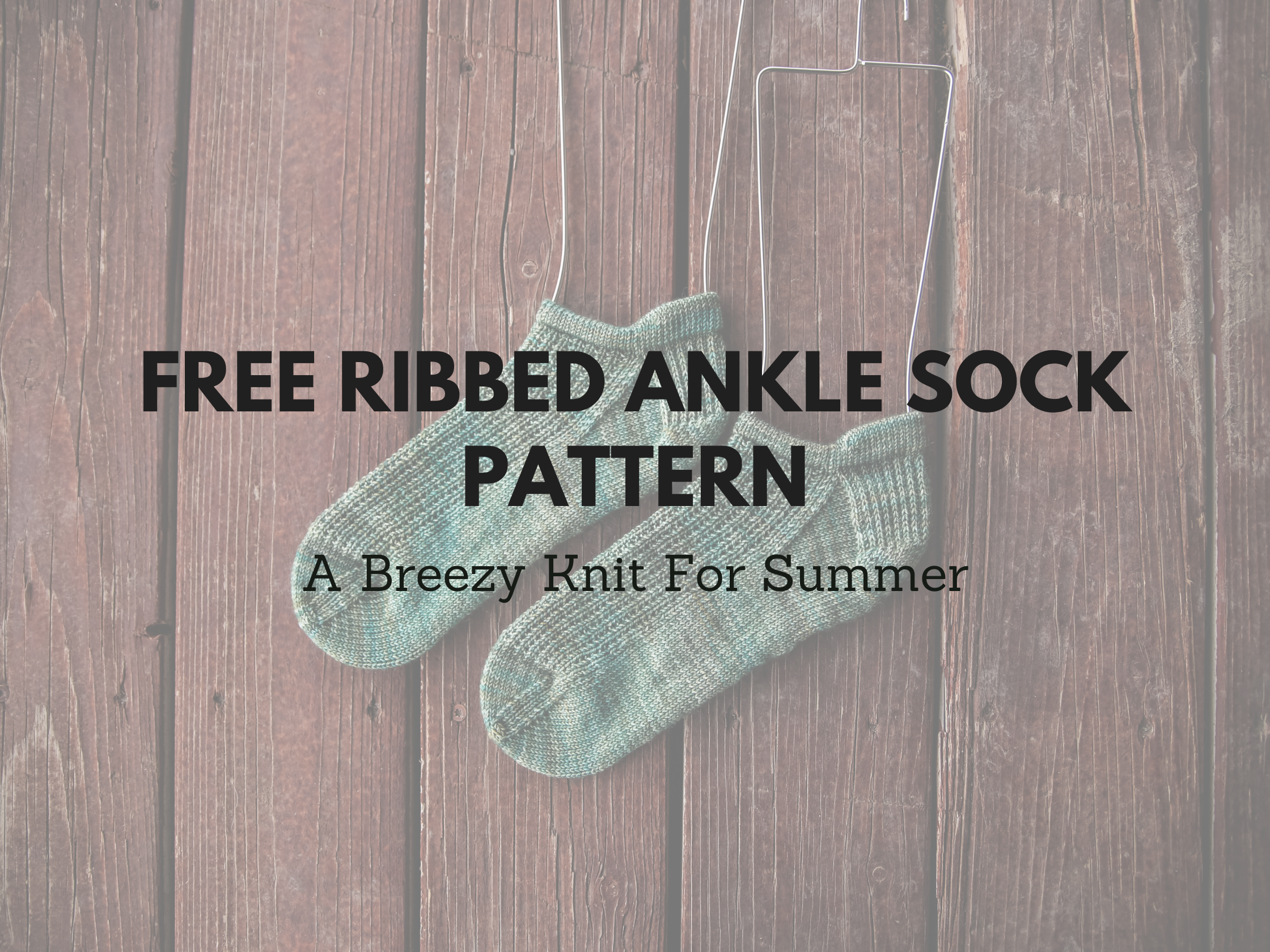
This free ribbed ankle sock pattern is one of my favorite options for knitters who want a classic everyday sock with just enough texture to keep things interesting, and it fits right in with my collection of free sock knitting patterns.
The all-over broken 1×1 rib gives these socks great stretch and a polished look while still being simple enough to memorize quickly. If you’ve been searching for a sock pattern that works for the whole family and feels more polished than plain stockinette, this pattern solves that problem beautifully with sizes written from baby through large adult.

If you love a sock that looks timeless, fits well, and stays interesting without becoming complicated, this is exactly that. The top down heel flap construction keeps things familiar, while the hemmed tabbed heel adds a polished detail that makes these stand out from basic ribbed socks.
What Materials Do You Need for This Free Ribbed Ankle Sock Pattern?
For this free ribbed ankle sock pattern, I kept the materials simple and practical so you can cast on without digging through your stash for specialty tools.
I love using KnitPicks Hawthorne for socks like these because it gives beautiful stitch definition and enough durability for everyday wear. The broken rib texture really pops in this yarn and helps highlight all of that subtle stitch detail.

Because the texture is simple but consistent throughout, using a yarn with good definition makes a huge difference in the final look. If you want those ribs to stand out clearly, this yarn is one of my go-to choices.
How Is This Free Ribbed Ankle Sock Pattern Constructed?
This free ribbed ankle sock pattern is worked from the top down using a traditional heel flap construction, making it a great choice if you already love knitting classic socks. The hemmed tabbed heel adds a polished little detail at the back and is created with short rows before being folded and joined into the heel.
The all-over broken 1×1 rib keeps the knitting engaging while still being easy to memorize after a few repeats. It creates a sock that feels stretchy and comfortable without the fabric becoming overly tight.

Because the texture runs throughout the entire sock, these are relaxing enough for evening knitting while still looking more detailed than a plain vanilla sock. They’re the kind of pattern you’ll likely knit more than once.
Looking for More Free Sock Knitting Patterns?
If you love this free ribbed ankle sock pattern, here are a few more sock patterns you may want to knit next:
These patterns all offer something a little different depending on the style you want to knit next—from simple everyday socks to lace and cable details. They’re perfect if you enjoy building a sock drawer full of handmade options.

Whether you’re knitting for yourself, your kids, or filling up the gift bin early, having a few reliable sock patterns on hand is always a good idea. This one is especially great when you want a stretchy fit and a classic textured look.
Judah Ankle Socks Pattern
Materials:
Yarn: Approximately 90 (130, 180) 210, 250 (290, 340) yds / 85 (120, 165) 195, 230 (270, 315) m of fingering-weight sock yarn.
Needles: US #1 / 2.25mm DPNs (or circular for magic loop)
Notions: Stitch markers, including one distinct beginning-of-round marker; stitch holders or waste yarn; and a blunt tapestry needle.
Gauge: Gauge: 32 sts and 44 rounds = 4 in / 10 cm in stockinette stitch worked in the round, after blocking.
Sizes: Baby (Toddler, Child) Large Child, Adult Small (Adult Medium, Adult Large).
Instructions are written in this order throughout.
Finished foot length, adjustable: 4 (6, 7¼) 8, 9 (10, 11¼) in / 10 (15, 18.5) 20.5, 23 (25.5, 28.5) cm.
The model size is a medium adult for a shoe size of ladies US size 10.
Abbreviations can be found on the last page
JUDAH STITCH PATTERN — worked in the round
Round 1: Knit.
Round 2: *K1, p1; repeat from * across the instep stitches.
Repeat Rounds 1–2.
Work the sole stitches in stockinette throughout. Continue the two-round pattern across the instep without restarting it at needle boundaries or between the gusset and foot sections.
Cuff
Cast on 40 (44, 52) 56, 60 (64, 72) sts. Place a distinct beginning-of-round marker and join to work in the round, being careful not to twist the stitches.
1st needle 20 (22, 26) 28, 30 (32, 36) sts
2nd and 3rd needle 10 (11, 13) 14, 15 (16, 18) sts each needle
Work in Stockinette for 4 (5, 5) 5, 5, (5, 6) rounds.
Work back and forth over the stitches on the first needle only. Leave the stitches on the second and third needles unworked.
Row 1 (RS): Knit to the last stitch on the first needle, w&t.
Row 2 (WS): Purl to the last stitch at the opposite end of the first needle, w&t.
Row 3: Knit to 1 stitch before the previously wrapped stitch, w&t.
Row 4: Purl to 1 stitch before the previously wrapped stitch, w&t.
Repeat Rows 3–4 1 (1, 2) 2, 2 (2, 3) additional times.
With RS facing, knit to the original beginning-of-round marker, working any wraps encountered together with the stitches they wrap. Then knit one complete round, working all remaining wraps together with their stitches.
Work in stockinette for 4 (5, 5) 5, 5, (5, 6) rounds.
Joining round: Fold the cast-on edge to the inside of the sock, matching each cast-on stitch with its corresponding live stitch. *Lift the corresponding cast-on stitch onto the holding needle and knit it together with the next live stitch; repeat from * around. Work loosely enough to preserve the cuff’s stretch.
40 (44, 52) 56, 60 (64, 72) sts remain.
Heel Flap
Work back and forth over the next 20 (22, 26) 28, 30 (32, 36) sts for the heel flap. Leave the remaining 20 (22, 26) 28, 30 (32, 36) instep sts on hold.
Row 1 (RS): *Sl1 purlwise with yarn in back, k1; repeat from * across. Turn.
Row 2 (WS): Sl1 purlwise with yarn in front, purl to the end. Turn.
Work Rows 1–2 8 (10, 12) 13, 14 (16, 18) times in total.
16 (20, 24) 26, 28 (32, 36) rows completed.
Heel Turn
Row 1 (RS): sl1, k12 (12, 14), 15, 16, (18, 20), ssk, k1, turn work.
Row 2 (WS): sl1, p7 (5, 5) 5, 5, (7, 7), p2tog, p1, turn work.
Row 3 (RS): Sl1, knit to 1 stitch before the gap, ssk across the gap, k1 if a stitch remains beyond the decrease. Turn.
Row 4 (WS): Sl1, purl to 1 stitch before the gap, p2tog across the gap, p1 if a stitch remains beyond the decrease. Turn.
Repeat Rows 3–4 until all heel stitches have been incorporated, ending after a WS row.
14 (14, 16) 16, 18 (20, 22) sts remain.
With RS facing, sl1 purlwise with yarn in back, then knit across the remaining heel stitches.
Gusset
Pick up and knit 9 (11, 13) 14, 15 (17, 19) sts along the first heel-flap edge, including 1 stitch at the corner to help close the gap. Place an instep marker.
Work Round 1 of Judah Stitch Pattern across the 20 (22, 26) 28, 30 (32, 36) held instep sts. Place a second instep marker.
Pick up and knit 9 (11, 13) 14, 15 (17, 19) sts along the other heel-flap edge, including 1 stitch at the corner.
Knit 7 (7, 8) 8, 9 (10, 11) heel sts. Move the distinct beginning-of-round marker to this point at the center of the sole.
52 (58, 68) 72, 78 (86, 96) sts.
Round 1: knit to marker, work front 20 (22, 26), 28, 30, (32, 36) in pattern, knit to bor marker
Round 2: knit to 3 sts before marker, k2tog, k1, sm, work in pattern to next marker, sm, k1, ssk, knit to end [2 sts dec]
Work the two-round gusset sequence 6 (7, 8) 8, 9 (11, 12) times in total.
40 (44, 52) 56, 60 (64, 72) sts.
Foot
Continue with Judah Stitch Pattern across the instep and stockinette across the sole until the foot measures approximately 3 (4¾, 5¾) 6¼, 7¼ (8¼, 9) in / 7.5 (12, 14.5) 16, 18.5 (21, 23) cm from the back of the heel.
For an adjusted foot length, begin the toe approximately 1 (1¼, 1½) 1¾, 1¾ (1¾,2¼) in / 2.5 (3, 4) 4.5, 4.5 (4.5, 5.5) cm before the desired finished length.
After completing the final foot round, remove the center-sole beginning-of-round marker. Knit 10 (11, 13) 14, 15 (16, 18) sts to the first instep marker. Replace that marker with the distinct beginning-of-round marker. The remaining instep marker marks the end of the instep.
The round now begins at the start of the instep, with 20 (22, 26) 28, 30 (32, 36) sts each for the instep and sole.
Toe
Round 1: K1, ssk, knit to 3 sts before the instep-end marker, k2tog, k1, sm; k1, ssk, knit to the last 3 sts of the round, k2tog, k1. 4 sts decreased.
Round 2: Knit.
Work Rounds 1–2 6 (7, 8) 9, 10 (10, 12) times in total.
16 (16, 20) 20, 20 (24, 24) sts remain.
For a left-handed tutorial of these decreases visit my youtube here
Cut yarn leaving a long enough tail to sew the toe closed. then graft toe using Kitchener stitch.
Make a second sock to match. Weave in all ends and block both socks to the intended finished measurements.
Kitchener stitch:
Arrange the remaining stitches on two needles, with the instep stitches on one needle and the sole stitches on the other. There will be 8 (8, 10) 10, 10 (12, 12) sts on each needle. Hold the needles parallel with the wrong sides of the sock together.
Cut the yarn, leaving a generous tail, and thread it through a blunt tapestry needle.
Setup: Pass the tapestry needle through the first stitch on the front needle as if to purl, leaving the stitch on the knitting needle. Pass it through the first stitch on the back needle as if to knit, leaving the stitch on the knitting needle.
Step 1: Pass through the first stitch on the front needle as if to knit and remove it from the knitting needle.
Step 2: Pass through the next stitch on the front needle as if to purl, leaving it on the knitting needle.
Step 3: Pass through the first stitch on the back needle as if to purl and remove it from the knitting needle.
Step 4: Pass through the next stitch on the back needle as if to knit, leaving it on the knitting needle.
Repeat Steps 1–4 until 1 stitch remains on each needle. Work Steps 1 and 3 once more. Adjust the grafting tension to match the surrounding stitches and weave in the end.
For a left-handed video tutorial of this visit my youtube here
Abbreviations
BOR: Beginning of round.
DPNs: Double-pointed needles.
k: Knit.
k2tog: Knit 2 stitches together; 1 stitch decreased.
p: Purl.
p2tog: Purl 2 stitches together; 1 stitch decreased.
pm: Place marker.
RS: Right side.
sl1: Slip 1 stitch purlwise unless otherwise stated.
sm: Slip marker.
ssk: Slip 2 stitches individually knitwise, then knit them together through their back loops; 1 stitch decreased.
st/sts: Stitch/stitches.
WS: Wrong side.
w&t: Wrap and turn. On a knit row, bring the yarn forward, slip the next stitch purlwise, take the yarn back, return the slipped stitch to the holding needle, and turn. On a purl row, take the yarn back, slip the next stitch purlwise, bring the yarn forward, return the slipped stitch to the holding needle, and turn. When subsequently working a wrapped stitch, lift its wrap and work it together with the stitch.

If you make these Judah Ankle Socks, I’d love to hear what you think! Leave a comment below and let me know who you’re knitting them for—or tell me your favorite sock yarn to use for ribbed socks.
This post may contain affiliate links, which means I may earn a small commission at no extra cost to you if you purchase through those links. I only recommend products I personally use and love.