
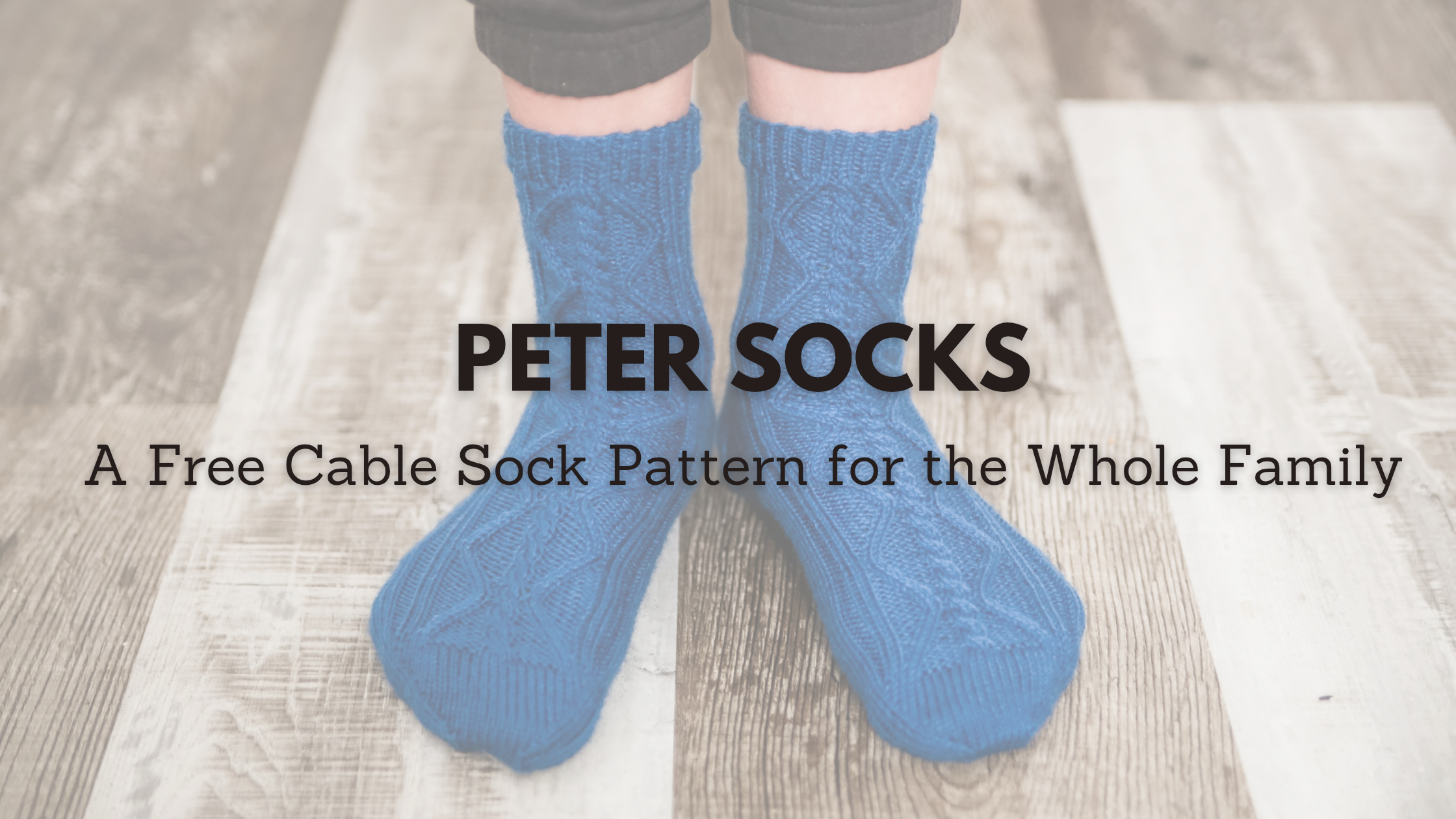
This free cable sock pattern is one of my favorite options if you love polished texture but still want something practical enough for everyday wear, and it fits right in with my collection of free sock knitting patterns.
The Peter Socks feature a classic top-down heel flap construction with a bold diamond cable panel running down the front of the leg and top of the foot for a polished, tailored look. If you’ve been searching for a sock pattern that feels a little more elevated than plain ribbing or stockinette, this one gives you that extra detail without becoming overly complicated.
The best part is that the cable panel coordinates perfectly with my Peter Sweater, Peter Vest, Peter Scarf and Peter Purse, so if you love matching knit pieces, this pattern ties the whole collection together beautifully.

If you want a sock that looks impressive but is still wearable enough for daily use, this free cable sock pattern checks every box. The diamond cable adds visual interest while keeping the rest of the knitting relaxing and familiar.
A simple repeat and classic construction make these the kind of socks you’ll want to knit again in multiple colors.
What Materials Do You Need for This Free Cable Sock Pattern?
To make this free cable sock pattern, I used:
- Hobbii Unicorn Solids
- Cascade Yarns Heritage
- 2.25mm Double Pointed Needles
I love using a smooth fingering weight sock yarn for these because it helps the diamond cable panel stand out clearly without getting lost in fuzz or heavy texture. Cascade Heritage works especially well if you want crisp stitch definition and a soft finished fabric.

Because the cable is the star of the design, I recommend choosing a solid or lightly tonal yarn rather than anything too busy. The cleaner the yarn, the more that textured panel will pop.
How Is This Free Cable Sock Pattern Constructed?
This free cable sock pattern is worked from the top down using a traditional heel flap and gusset construction. The diamond cable panel runs continuously down the front of the leg and across the top of the foot, creating a seamless flow of texture from cuff to toe.
If you’re comfortable knitting basic cables and heel flap socks, this pattern should feel very approachable. The rest of the sock stays simple so your focus can remain on the featured cable panel without becoming overwhelming.
If you enjoy the look of cabled socks but want a more understated design next, the Asa Socks free knit sock pattern uses small cable accents with the same familiar top-down heel-flap construction.

One tip I always recommend when knitting cabled socks is to keep your cable tension relaxed. Sock fabric is already knit at a tighter gauge, so pulling cables too tightly can make the finished sock less stretchy than intended.
Looking for More Free Sock Knitting Patterns?
If you love this free cable sock pattern, here are a few more sock patterns you may enjoy next:
These patterns all offer different textures and stitch details while keeping that same wearable, practical feel. Whether you prefer lace, cables, or simple textured stitches, there’s something in the collection for every kind of sock knitter.

If Peter Socks are your style, chances are you’ll enjoy the rest of these textured sock designs too. They all pair timeless details with constructions that are comfortable to wear and enjoyable to knit.
Peter Socks Pattern
Materials:
Yarn: (1, 1) 1, 1 (1, 2) skeins of Hobbii Unicorn Solids (Affiliate Link) 437yd/100g Needles: US #1 / 2.25mm DPNs (or circular for magic loop)
Notions: stitch markers, needle
Gauge: 32sts x 44rows per 4x4ins or 10x10cms
sizing:
(toddler, child,) lg child, adult S, (M, L)
Finished measurements (unstretched):
Foot Length (adjustable): (6, 7.25), 8, 9, (10, 11.25) ins or (15, 18.5) 20, 23 (25.5, 28.5) cms
The model size is a large child for a show size of boys US size 13. Abbreviations can be found on the last page.
PETER CENTER CABLE STITCH PATTERN:
Row 1 (right side) – p4, 2/1RPC, 2/2LC,
2/1LPC, p4
Row 2 – p4, k2, p1, k4, p1, k2, p4
Row 3 – p3, 2/1RPC, p1, k4, p1, 2/1LPC,
p3
Row 4 – p3, k2, p2, k4, p2, k2, p3
Row 5 – p2, 2/1RPC, p2, 2/2LC, p2,
2/1LPC, p2
Row 6 – p2, k2, p3, k4, p3, k2, p2
Row 7 – p1, 2/1RPC, p3, k4, p3, 2/1LPC,
p1
Row 8 – p1, k2, p4, k4, p4, k2, p1
Row 9 – 2/1RPC, p4, 2/2LC, p4, 2/1LPC
Row 10 – k2, p5, k4, p5, k2
Row 11 – 2/1LPC, p4, k4, p4, 2/1RPC
Row 12 – p1, k2, p4, k4, p4, k2, p1
Row 13 – p1, 2/1LPC, p3, 2/2LC, p3,
2/1RPC, p1
Row 14 – p2, k2, p3, k4, p3, k2, p2
Row 15 – p2, 2/1LPC, p2, k4, p2, 2/1RPC,
p2
Row 16 – p3, k2, p2, k4, p2, k2, p3
Row 17 – p3, 2/1LPC, p1, 2/2LC, p1,
2/1RPC, p3
Row 18 – p4, k2, p1, k4, p1, k2, p4
Row 19 – p4, 2/1LPC, k4, 2/1RPC, p4
Row 20 – p5, k8, p5
Cuff
Cast on (48, 52) 56, 60, (64, 72) sts, join for working in the round. Separate stitches on your dpn as follows:
1st needle (24, 26) 28, 30 (32, 36) sts each needle
2nd needle (12, 13) 14, 15 (16, 18) sts each needle
3rd needle (12, 13) 14, 15 (16, 18) sts each needle
Work in 1×1 rib (k1p1 around) for (8, 10) 10, 12 (12, 14) rounds
Leg
Set-up round – k[(1, 2) 3, 4 (5, 7)], m1, p1, k2, pm, m1, p4, k8, p4, m1, pm, k2, p1, m1, k around. (52, 56), 60, 64 (68, 76) sts
Work Peter Stitch pattern as follows:
K[(1, 2) 3, 4 (5, 7)], p2, k2, sm, work Peter Stitch Pattern to marker, sm, k2, p2, knit around until piece measures (3.5, 4) 4.5, 5, (6, 7)ins or (9, 10) 11.5, 12.5 (15.5, 18) cms from cast on (or desired length)
Heel Flap
Next round: work needle 1 in pattern. These worked stitches will now be placed on hold (you will NOT be using them for the heel).
The remaining (24, 26) 28, 30 (32, 36) sts will be your heel worked as below:
Row 1 (RS): (sl1, k1) to end, turn work.
Row 2 (WS): sl1, purl to end, turn work.
Work rows 1-2 a total of (11, 12) 13, 14, (15, 17) times.
This is a total of (22, 24), 26, 28, (30, 34) rows.
Heel Turn
Row 1 (RS): sl1, k(14, 14), 16, 16, (18, 20), ssk, k1, turn work
Row 2 (WS): sl1, p(7, 5) 7, 5, (7, 7), p2tog, p1, turn work
Row 3: sl1, knit to 1 st before the gap, ssk, k1, turn work
Row 4: sl1, purl to 1 st before the gap, p2tog, p1, turn work
Repeat rows 3-4 until all stitches have been worked: (16, 16), 18, 18, (20, 22) sts remain on heel.
Knit across these heel stitches slipping the first st.
Gusset
Pick up and knit (11, 13), 14, 15, (16, 18) sts along the edge of heel flap, PM, work (28, 30), 32, 34, (36, 40) in pattern, PM, pick up and knit (11, 13), 14, 15, (16, 18)sts along heel flap, k(8, 8) 9, 9, (10, 11) sts, mark the new BOR (located at the bottom of the foot). [(66, 72) 78, 82, (88, 98) sts]
Round 1: knit to marker, work to marker in pattern, knit to bor marker Round 2: knit to 3 sts before marker, k2tog, k1, sm, work (28, 30), 32, 34, (36, 40) in pattern, sm, k1, ssk, knit to end [2 sts dec]
Work rounds 1-2 a total of (8, 8) 9, 9, (10, 11) times. [(52, 56), 60, 64 (68, 76) sts]
Foot
Shift beginning of round (BOR) remove marker as follows: remove marker, k(12, 13) 14, 15 (16, 18), place marker – this is the new BOR, located at the side of the foot.
Keep the second marker after the instep stitches in place.
Continue working in the round, keeping the top of foot in pattern, until the piece measures (5, 6) 6.5, 7, (8, 9)ins or (12.5, 15) 16.5, 18 (20.5, 23)cms from back of heel, or (1, 1.5) 1.75, 2, (2, 2.25)ins or (2.5, 3.5) 4.5, 5 (5, 5.5) cms short of desired foot length.
Pattern and images © 2025 Amanda Morse All rights reserved. Distribution of this pattern is prohibited. Do not make copies outside of personal use. Permission is granted to sell what you make from this pattern.
Peter Socks
Toe
Set-up Round – k[(0, 1) 2, 3 (4, 6)], ssk, k2tog, k1, remove marker, knit across in pattern, remove marker, k1, ssk, p2tog, k[(0, 1) 2, 3 (4, 6)], place marker, knit around. (48, 52) 56, 60, (64, 72) sts
You will now work in stockinette for the remainder of the sock.
Round 1: k1, ssk, knit to 3 sts before marker, k2tog, k2, ssk, knit to 3 sts before end of round, k2tog, k1 [4 sts dec]
Round 2: knit around
Work rounds 1-2 a total of (8, 8) 9, 10, (10, 12) times. until (16, 20) 20, 20, (24, 24) sts remain.
Cut yarn leaving a tail long enough to sew the toe closed, then graft toe using Kitchener stitch.
Weave in all ends
Kitchener stitch:
Place half the stitches on one needle, half the stitches on the other needle, (top and bottom NOT side to side)
Cut yarn (leaving a long yarn tail) and thread through a blunt needle. Set-up steps: Insert needle purlwise (back to front) through the first st on front needle, leaving the st on the needle. Then insert needle knitwise (front to back) through the first st on the back needle, leaving the st on the needle. Step 1: Insert needle knitwise through first st on front needle, then slip this st off the needle.
Step 2: Insert needle purlwise through the second st on front needle, leaving the st on the needle.
Step 3: Insert needle purlwise through first st on back needle, then drop this stitch off the needle.
Step 4: Insert needle knitwise through second st on back needle, leaving the st on the needle.
From this point to the end, repeat steps 1-4.
Kitchener stitch can be intimidating, but you get into a rhythm:
Front needle: knitwise drop off, purlwise leave on,
Back needle: purlwise drop off, knitwise leave on,
Repeat!
At the end of the row, there is only 1 stitch left on each needle.
Work steps 1 and 3 once more.
Abbreviations
k – knit
P – purl
sm – slip maker
pm – place marker
bor – beginning of round
st – stich
sts – stitches
k2tog -knit 2 stitches together
ssk – slip next st knitwise, slip next st knitwise, place stitches back onto left needle, knit both slipped sts together
m1 – make one
w&t – wrap and turn – wrap the yarn around the next stitch, turn work 2/1LPC – slip the next 2sts onto cable needle and hold at front of work, p1 from left needle, then k2 from cable needle
2/1RPC – slip, the next st onto cable needle and hold at back of work, k2 from left needle, them p1 from cable needle
2/2LC – slip the next 2 sts onto cable needle and hold at front of work, k2 from left needle, k2 from cable needle

Have you knit matching pieces from the Peter collection yet? Let me know in the comments which Peter pattern is your favorite—I always love seeing which coordinating designs people choose to make together!
This post may contain affiliate links, which means I may earn a small commission at no extra cost to you if you purchase through my links. Thank you for supporting my business!